Thursday, February 28, 2013

Vincent Starrett's Lionel Johnson

From a rare pamphlet Three Poems published by Edwin B Hill 'Ysleta' 1933 with an intro by Vincent Starrett - this Lionel Johnson poem found on the flyleaf of a work by Robert Louis Stevenson. These are possibly from Starrett's own collection.

Because with many a goodly word,
My flagging pulses you have stirred,
And, when to me high noon seemed night,
Have flooded me with gallant light:

I, who, to this, your island home,
A stranger, yet a friend have come,
Give, for your memorable sake,
'This poor, best wish, that I could make.

 Also a Johnson poem saluting Oscar Wilde on the publication of Dorian Gray. This has the true decadent 1890s feel (it was in Latin with a recent translation via the Et in Arcadia Ego site). Starrett states that this poem addressed to Oscar Wilde is from an original 'privately owned' manuscript (a valuable item) - it ends thus:

Hic sunt poma Sodomorum;
Hic sunt corda vitiorum;
Et peccata dulcia.
In excelsis et infernis,
Tibi sit, qui tanta cernis,
Gloriarum gloria

Here are the apples of Sodom!
Here are the hearts of corruption
And sweet sins!
In heaven and hell
May there be to you, who understands so much,
Glories of glories!

Wednesday, February 27, 2013

Gordon Selfridge & The Romance of Commerce


Gordon Selfridge's The Romance of Commerce was published by John Lane-The Bodley Head in 1918. It has chapters on ancient commerce, China, Greece, Venice, Lorenzo de' Medici, the Fuggers (600 year old German retailing dynasty) the Hanseatic League, fairs, guilds, early British commerce, trade and the Tudors, the East India Company, north England’s merchants, the growth of trade, trade and the aristocracy, Hudson’s Bay Company, Japan, and 'representative businesses of the 20th century' (i.e. Sefridges-- an excellent study of running a huge store, distribution, chains of command with a 6 foot folding chart).This copy is signed by the Merchant Prince - 'To travel hopefully is better than to arrive and all true success is labour. H. Gordon Selfridge 1929.'

Tuesday, February 26, 2013

Anthony Blunt 'The Mind in Chains' 1937

 In the post on the Victor Rothschild we mentioned that he had been at Cambridge with the art expert and spy Anthony Blunt. It is known that he lent Blunt £100 to buy a Poussin  which was sold for £100,000 50 years later as part of his estate. Anthony Blunt a Cambridge don by the early 1930s, was formally recruited to Soviet intelligence in 1937, according to recently released KGB documents, much later than earlier accounts. This explains the seemingly cavalier act of openly writing left-wing (Marxist) art polemic such as his 1937 essay 'Art Under Capitalism and Socialism' published in The Mind in Chains.

 David Mcknight writes in Espionage and the Roots of the Cold War that- 
'Blunt's left wing articles, and his 1935 trip to the USSR, subsequently almost blew his cover. In 1939, as he took tentative steps toward his goal of penetrating British intelligence by joining in the Field Security Police, he was questioned about them. Again, wartime laxness saved the day. In any case Blunt was accepted into MI5 in 1940 where he soon transferred to his preferred section -- counter-espionage -- enabling him to report on measures against Soviet and German intelligence.'  Obviously no-one had closely read his piece in this red-jacketed book. Blunt writes:

Monday, February 25, 2013

Victor Rothschild Collection

Sold in October 2000. Large collection of books by Lord Rothschild-- almost all signed presentation copies to his friend and tutor Dadie Rylands..12 books and 23 pamphlets and academic offprints,also a letter from Victor Rothschild and some ephemera. 

Lord Rothschild age 23 and 63
The collection reflects most aspects of his varied life--science, literature, book and antique collecting, banking, education, Judaism, gastronomy etc., Items include-- 1. ‘The Rothschild Library’ (2 large volumes 1954). Catalogue of a collection  18th Century printed books and manuscripts formed by Lord Rothschild. Signed presentation copy to Dadie Rylands "with many thanks for giving me a new interest".  Loosely inserted  is a letter to Dadie Rylands  - and a proposal for printing the book.  Rylands is also mentioned in the forward of this book. 2. ‘Some Unpublished Marginalia by Jonathan Swift .100 copies only. Pamphlet 1945. 3. Livre D’Or. Lavish leather bound quarto published by the Roxburghe Club and collecting papers of his ancestor Baron Ferdinand de Rothschild. Signed presentation copy to Dadie Rylands. 4. Privately printed books on the Lycurgus Cup and the Nelme Cup. 5. The Jews in Germany  - - pamphlet of a speech delivered in 1938 by Lord Rothschild. Presentation copy. 6. The History of Tom Jones. A Changeling. 1951. Privately printed 1951. The  fascinating story of a faked copy of Fielding’s book and VR’s purchase of it and the subsequent lawsuit against the offending bookseller. Signed presentation copy. 7. You Have it, Madam. 1980. The story of the purchase of Suez canal shares by Disraeli and Baron Lionel de Rothschild. Signed presentation copy. 8. The Shadow of A Great Man. 1981. An essay on Nathan Mayer Rothschild the founder of the dynasty. Signed presentation copy. 9. Fertilisation. A scientific textbook published in 1956 by Methuen. Signed presentation copy. 
There are pamphlets on spermatozoa, his book ‘A Classification of Living Animals, a pamphlet on Trout’s Eggs, texts of various lectures, a pamphlet written with his daughter on his attempt to give up smoking , a book of his favourite recipes, offprints from the Scientific American etc., Almost all books etc., are in fine condition, many bear the bookplate of Dadie Rylands. £1500 (sold)

Dadie Rylands (1902 - 1999) was a Cambridge fellow, literary scholar and theatre director. His rooms at King's College had colourful murals by his friend Dora Carrington. He could be seen cycling around Cambridge in leather shorts into his 90s. He had been one of Victor Rothschild's tutors while at Cambridge and VR rewarded him with a Shakespeare First Folio on leaving. Victor Rothschild (1910 - 1990) later Lord Rothschild was a scholar, biologist, cricketer and bibliophile. At Cambridge he was a member of the Apostles and a friend of Guy Burgess and Anthony Blunt. For a time he was thought to be the 'fifth man'. He employed nicorette gum in his attempt to give up smoking...

Heathfield School circa 1915


A book ( Bracebridge Hall 1904) presented to Rita Gulbenkian by fellow members of her form in about 1915. Dated by identifying one of her fellow pupils - Eileen Agar, the British surrealist painter and an old girl of Heathfield school. Heathfield is an exclusive  girl's boarding  school standing in 36 acres of grounds on the outskirts of Ascot and was founded in 1899 by Eleanor Beatrice Wyatt. Its pupils seem quite international - the girl the book was presented to was Armenian - the daughter of Calouste Gulbenkian, one of the world's richest men and brother of Nubar Gulbenkian, an eccentric billionaire. She was born in 1900 and Eileen Agar in 1899. The school's motto was (and still is) 'The Merit of One is the Honour of all.' Clicking on the image gives a very clear picture of all the names...

Sunday, February 24, 2013

Sex Pistols last UK concert 1977 - eye witness account

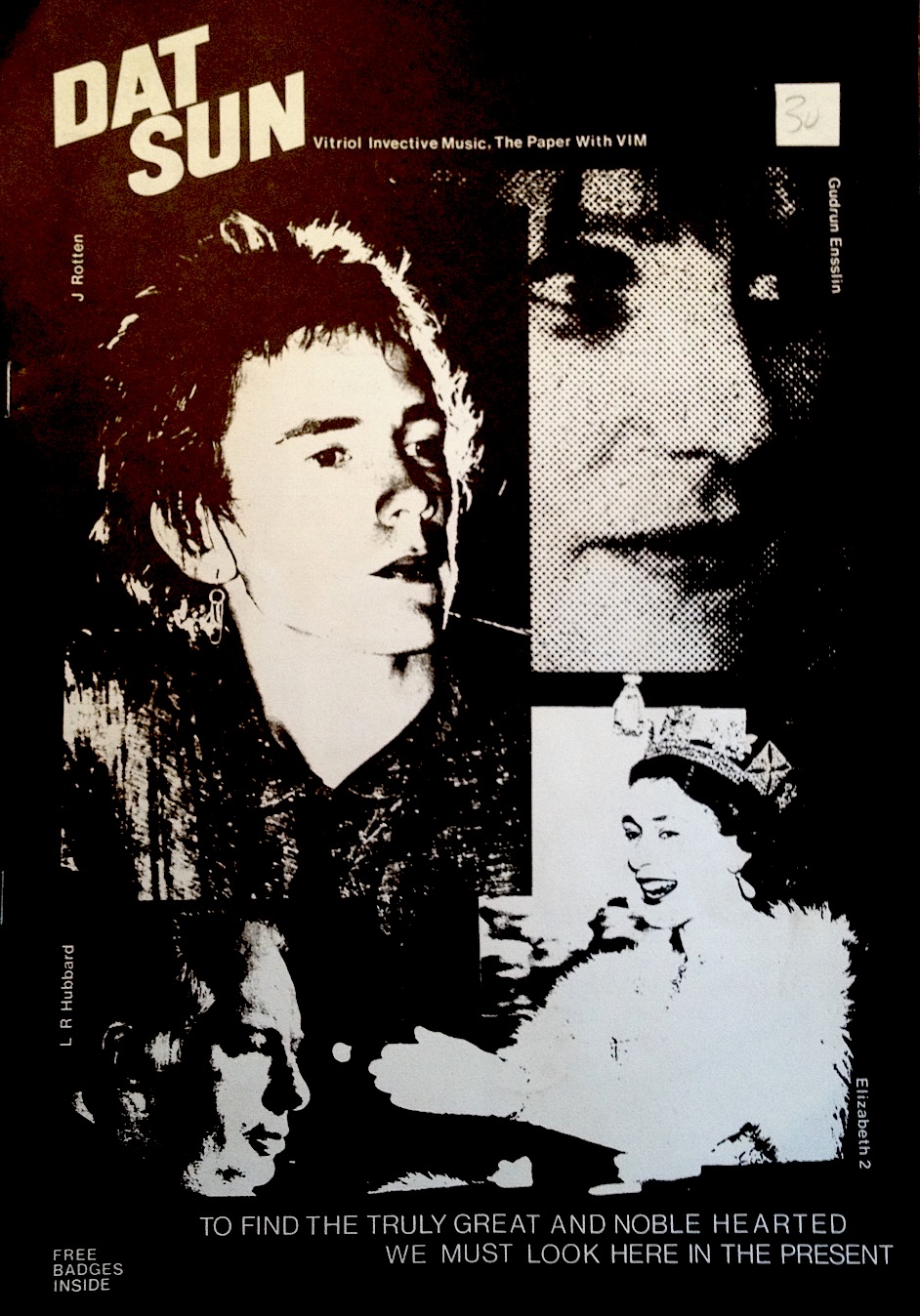
Found in a scarce 1977 punk fanzine Dat Sun which also has a Wyndham Lewis inspired 6 page 'Blast' against current stuff. Anonymous*. It covers the last (or penultimate) appearance of the group on British soil at Cromer, Norfolk on Christmas Eve 1977 (punk's annus mirabilis.)

God rest you merry gentlemen in a quarter of an hour the Sex Pistols will play. We slip into the Links pavilion and buy tickets - easier than the village dance. Due to slippery disputes and reports of cancellation in the East Anglian they had not sold out. Dub Disco falls heavily on country in years, 75% East Anglian punks. Johnny Rotten in fashionably squashed pith pelmet surveys the audience critically from the balcony : Sid Vicious tries on T-shirts. The audience is a bit shy of them, and pretends it hasn't noticed. There is no mystique about the boys arriving in a limo or helicopter at the last big moment - the group are, it seems, actually waiting for everyone to turn up before they play.

Saturday, February 23, 2013

Edward Gorey - West Point & the Dictionnaire Infernal

A card from Edward Gorey to the great Baron Corvo expert Donald Weeks. Dated 1965. Donald had been an early fan of EG and used his art as illustration in the General Motors house magazine Friends of which he was art editor. The Dictionnaire Infernal was a typical present from Donald, a serious collector of curious and out of the way books. It is a work by de Plancy on demonology, organised in hellish hierarchies. There were several editions of the book, but the best known is the edition of 1863, in which 69 illustrations were added to the book -drawings which try to depict the descriptions of the appearance of several demons. This is most likely the edition he sent to 'Ted.' The illustration on the card is a gloomy 19th century steel engraved view of West Point. Its significance is obscure but it has a Gorey style about it. The influence of the illustrations in the  Dictionnaire Infernal  on Gorey's oeuvre is worthy of research! As for Bette Davis, it is interesting to see she was already a cult nearly 50 years ago.


 'Dear Don. Many thanks for the Dictionnaire Infernal, I've only had a chance to dip into the text but just the illustrations are marvelous. I expect one of these days you'll see bits of them turning up in the work of you-know-who. We are in the throes, and I do mean throes, of a Bette Davis festival at the New Yorker theatre. Sheer delight. Best, Ted.'

Friday, February 22, 2013

Carrington Bookplate

Bookplate for Lytton Strachey by Dora Carrington (1931)


A miniature piece of Bloomsbury history - this small bookplate by the artist Dora Carrington measures 1 3/8 inches high by 1 3/4 inches wide in it's largest version. The large version is rarer than the smaller but both have now become quite elusive. The tiny postage stamp size one measures only 1" by 3/4 ". Both have the words Lytton Strachey in a plaque or cartouche with folded edges surrounded by net-like cross hatching in a dark sepia tone.

A relic of the artist and Bloomsbury goddess. Carrington wrote of this bookplate in her diary (March 20 1931) rather prophetically:-

 'As I stuck the book plates in with Lytton I suddenly thought of Sothebys and the book plates in some books I had looked at, when Lytton was bidding for a book and I thought: These books will one day be looked at by those gloomy faced booksellers and buyers. And suddenly a premonition of a day when these labels will no longer (be) in this library came over me. I longed to ask Lytton not to stick in any more.'

 He died 10 months later. In despair at his death Carrington shot herself a few months after. The tiny bookplate is not uncommon, for example Strachey (or Dora Carrington) placed it in every volume of a complete Oxford Dictionary. However he was a bibliophile so it can also turn up in rare and valuable books. In commerce it can make as much as £100, but other bookplates by Carrington are much more elusive.


'Carrington' was one the best Bloomsbury movies, it starred Emma Thompson and Jonathan Pryce - Pryce was an exceptional Strachey and Rufus Sewell a fiery Mark Gertler. A sample from the Christopher Hampton script - Gertler is peeved that Carrington is in love with Strachey:

Mark Gertler: Haven't you any self-respect?
Dora Carrington: Not much.
Mark Gertler: But he's a disgusting pervert!
Dora Carrington: You always have to put up with something.

Thursday, February 21, 2013

Puzzling Palindrome

From 100 Interesting Puzzles and Problems by Zodiastar (London 1939) this palindromic puzzle:

A word that is spelt exactly the same forwards as backwards is known as a 'palindrome.' Two examples are refer and tenet. Below is set out an excerpt from a story - there are eight words missing in it. All are palindromes. Can you supply them?

He got out his ---- box and looked through his valuables. There were two photos of his sister, one named ---, the other ------. He gazed at them affectionately. One was married to an official in the land where ----- have ruled for centuries: the other to a man of high ----- rank. Just at that moment he heard someone calling him by name'---' they cried. He rushed out of the window and looked towards the ----- crossing. There, lying bound to the tracks was a man with a --- in his mouth.'

Answers (there are probably others) Ada, Deed, Shahs, civic, Hannah, Bob, gag, level

Another thornier problem - "A certain sum of money when written down in pounds, shillings and pence, uses exactly the same  figures in the same oder as when written in farthings...
Answer £12 12s 8d which equals 12128 farthings. Simples.

E. V. Knox ("Evoe.")


A rare photo of 'Evoe' added from our archives. Edmund George Valpy Knox (1881 - 1971), comic writer, poet and satirist who wrote under the pseudonym 'Evoe'. He was editor of Punch 1932-1949, having been a regular contributor in verse and prose for many years. He was married to the daughter of the Winnie the Pooh illustrator E.H.Shepard. Mary Shepard in her turn illustrated Mary Poppins. His daughter from an earlier marriage was the Booker prize winning novelist Penelope Fitzgerald - known in the family as 'Mops' and author of a book on the gifted Knox family.

There are a few recorded quotations  by  Evoe. One that would never be said these days was (from memory) 'the room smelled as if nobody had been smoking in it..' A snatch of verse that still has some currency are the last two lines of a parody of John Masefield (The Everlasting Percy) published in his slim 1926 volume Poems of Impudence:  

When I was young I was so wicked,
I used to ride without a ticket,
And travelled underneath the seat
Down in the dust of people's feet....
I have a flapper on the carrier.
Some day I'm going to marry her.

Working for Punch he was obliged to provide golfing humour and this quote from him is quite well known: 'Golf is played with a number of striking implements more intricate in shape than those used in any form of recreation except dentistry.'

Gadsby

Ernest Vincent Wright. Gadsby. A Story of Over 50.000 Words Without Using the Letter E. Los Angeles, 1939.

A literary curiosity and a legendary rarity. The author E.V. Wright (1872-1939) wrote Gadsby in five and a half months, on a typewriter with the letter 'e' tied down, "so that none of that vowel might slip in, accidentally". He finished his work about the middle of February 1937, and the typescript was illustrated in The Los Angeles Times on 24 March. After seeking a publisher for 2 years Wright finally settled on a vanity press (Wetzel) in LA. It is said that the publication of Gadsby coincided exactly with the author's death on 7 October 1939; however a copy is known with an inscription dated two months earlier and the copyright-deposit copy was received five months later.

From the introduction:

"People as a rule will not stop to realize what a task such an attempt actually is. As I wrote along, in long-hand at first, a whole army of little E's gathered around my desk, all eagerly expecting to be called upon. But gradually as they saw me writing on and on, without even noticing them, they grew uneasy; and, with excited whisperings amongst themselves, began hopping up and riding on my pen, looking down constantly for a chance to drop off into some word; for all the world like seabirds perched, watching for a passing fish! But when they saw that I had covered 138 pages of typewriter size paper, they slid onto the floor, walking sadly away, arm in arm; but shouting back: "You certainly must have a hodge-podge of a yarn there without *us*! Why, man! We are in every story ever written *hundreds of thousands of times! This is the first time we ever were shut out!.."

A book much admired by the Pataphysicians and Oulipans especially Perec and Queneau who both searched for copies. The rarity is due to one of those warehouse fires that frequently occur in the history of unfindable books (Nabokov's Despair, Beckett's Murphy, Moby Dick and Forster's Alexandria to name a few -- enemy action is also a great rarity creator...) Wetzel's novelty warehouse went up in a mighty blaze (a fireman died) along with most copies of the ill fated novel, it was never reviewed and only kept alive by the efforts of a few avant garde French intellectuals and assorted connoisseurs of the odd, weird and zany.

It has been reprinted this century. Perec wrote an e-less book 'La Disparition' (Paris 1969). Possibly in honour of Gadsby it was also 50,000 words. These books with grammatical restrictions are now known 'Lipograms'. Craig Brown's recent book One on One - 101 chance meetings (Proust/ Joyce etc.,) each described in exactly 1001 words is a late Oulipo influenced work, so the tradition goes on...
Perec's work was translated into English sans e's as A Void by Gilbert Adair. Try writing just a paragraph without it - it is horribly hard and you must continually look for odd ways of saying things...[From our sister site Bookride with a few alterations and additions, they also have much on its value - however it is a hard book to find and a hard book to sell especially without a jacket.]

Tuesday, February 19, 2013

Radio Nervine


1920s booklet for Nervine. Half the book is about radio and the other half pushing Nervine pills (which were also advertised on the radio.) Pain pills, laxatives, liver pills and Dr. Miles' 'Alterative Compound' - a blood purifier. Dr. Miles mentions St. Vitus dance as something that his nerve pills can sort out - as well as 'the blues.'  The boy in the picture would now be plugged into his iPod.

Health--Most of us can have it
  Good health is the natural state of mankind. All sickness is due to a violation of the laws of health. Most children are born healthy. All would be if their parents had never–through ignorance, indifference or carelessness–violated some of these rigid laws. The loss to the individual and to humanity, through ill health, is so great as to be almost unbelievable...

  Don't delay. Buy the remedy suited to your trouble today. A few doses may do you more good now than a dozen bottles next week or next month.

Monday, February 18, 2013

Philip Oyler (the mage Trelawney)

Philip Oyler (1880 - 1973) Writer, poet, farmer, religious thinker and the acknowledged original (with Aleister Crowley) of the character Dr. Trelawney in Anthony Powell's 12 volume The Music of Time.

A work from 1960. Later in life he seems to have become a fairly conventional Christian with anti-urban pastoral yearnings.


Leaves from the Tree of Life or Fruits of Experience.

A few quotations:

In the way of God it is not necessary to read or write. What is of paramount importance is that we should at all times listen most attentively to the promptings of conscience, the small sweet Voice that tells us quite clearly when we ignore it. Study  of the scriptures or any eloquent sermon will avail nought unless we listen to that Voice.

Giving a toy to a baby is the way to make a baby look outside himself for happiness. Babies show their contempt for it by throwing it away, but fond parents pick it up again!

Only the poor know how to give for they know what it means to lack.

If we cannot be content with a little, we will not be content with a lot either. It is not the quantity but the outlook which is the deciding factor.

Anti-city, pro-country sentiments -'man creeps about in his cities, ignoring his destiny and his duty, blinded by the worship of self to such an extent that he does not know why he has been born.His brain is swollen; his heart shrivelled up...God help us!

Bookride notes '...Oyler went on to live a long life as an educationalist, Utopian, 'New Lifer', country writer and 'Prophet of the Soil.' ... Tim D'Arch Smith, in the revised edition of his excellent work 'The Books of the Beast' has a chapter on Dr. Trelawney ('thaumaturge and seer')

Bookmarks of the Bay Area Bookshops

Small collection of bookmarks of Bay Area used bookshops. Most have now gone but Moe's is still there on Telegraph in Berkeley and More Moe's is now on the 4th floor. Peter Howard's Serendipity in Berkeley went last year and is much missed. No bookmark found for that shop but may post one of his annual feast broadsides if it can be located...


Sunday, February 17, 2013

Ignition!

John D. Clark. IGNITION! An informal history of liquid rocket propellants. Rutgers University, USA 1972.

This is rocket science. Cult book among rocket geeks or the aspiring 'rocketeer.' Includes amusing stories e.g. an attempt to use skunk oil as a fuel. Talk about stinks and bangs! 232 pages with illustrations. A very rare book much wanted by rocket enthusiasts and never reprinted... Clark is /was a great enthusiast in the line of Britain's sky man Patrick Moore. He has some useful cautionary tales e.g. he describes Red Fuming Nitric Acid (RFNA), a powerful oxidizer, as a substance that "attacks flesh with the avidity of a school of piranha." It can now be read online in a good version at Science Madness (3.5 MB)
Actual copies sometimes surface but tend to command several hundred dollars (sky high prices) but the pdf version is now very good.