Showing posts with label Punk. Show all posts

Sunday, January 18, 2015

The Dynamiter - first punk mag?


At a revolutionary printing office*
Found - a review in a 'monthly magazine of bibliography' Book Lore (1886) of  a new magazine The Dynamiter : a record of literary bombshells, books old and new, flung into the camp of the orthodox [London : Printed and published for the proprietor by Thomas Shore**, Jun.,] WorldCat shows that it  went to just one issue. The only copy in world libraries is at the British Library in Euston. Amazon list it as 'currently unavailable' assigning it the ASIN number ASIN: B0000EF989. The publisher, and probably the author, seems to have been a minor John Camden Hotten style publisher of the curious, seditious & the scabrous. WorldCat lists another work almost certainly by  by him:

Men V. Machinery. Suggestive Facts and Figures, urging National Control of National Powers of Production. By Thomas Shore. With Preface by H. Halliday Sparling. 20 pp., price 2d. 

This hints at quite advanced, possibly revolutionary, political views and brings to mind the world of Conrad's The Secret Agent and nihilists in blue-tinted glasses... Shore's 1886 periodical was eight pages in length and printed on red paper rendering it hard to read. It may have been a simple bookish curiosity about strange and outlandish books, not uncommon at the time. However the Book Lore review mention of "oatmeal upon which to cultivate literature and revolution" and "blood red paper" suggests a more provocative, contrarian purpose and it may have a place in a completist collection of punk literature (along with Wyndham Lewis's puce monster BLAST also 'flung into the camp of the orthodox' 28 years later.) The review in Book Lore reads thus: [We have left in the news item that follows it suggesting John Ruskin was a graffiti artist.]

No. I of The Dynamiter, which is said to be "a record of Literary Bombshells, books old new, flung into the camp of the orthodox," consists of eight quarto pages, printed on blood-red  paper, and the editor says that since "every man has to pay rent, rates, and taxes, as well as buy food and clothing, it is a farce to talk about working wholly and solely for love of a cause."  The information supplied by this engaging print is not, judging from the solitary number before us, of any value;

Monday, September 29, 2014

A Bill Childish ephemeroid


Found a Billy Childish (and Sexton Ming) broadsheet listing 24 books from their Phyroid Press 1978 - 1982. It gives a useful bibliography of their publications (some are now rare) and it also lays down some ground rules when dealing with this esteemed publishing house:-


1. Do not swager yu bollocks when you come in
and dont give us any arty shit
yu will resive a brocken jaw and apendiges pretty qwick

2. If yu bottle out n turn out to be a whimpy one
we will not give you respect
infact we will do you down.
3. Do not talk of CND feminism or any of 
that crap or we will bust yu lip

We talk the strong langwige that only children can bear
we drink neat carosean n smoke full strength navi-cut
our noses are smokeing chimny stacks
they fall over and crush yu wife and kids


We feed on boil pork n black cocain...[etc.,]


Friday, June 13, 2014

A Post-Punk Manifesto (1993)

Found in a now unfindable short-lived magazine Verbal Abuse from 1993 - a post punk manifesto by 'editrix' Chi Chi Valenti in a special Punk issue 'No/ The Future.' Coming out of New York's early 90s underground demi-monde (especially the legendary club Jackie 60) the magazine was, in this issue, boldly keeping the punk flag flying 15 years after its demise. It was a time of  AIDS and cyberpunk, just pre internet… Vogue was championing punk fashion for that fall. Contributors included Richard Hell, Matthew Barney, Patti Smith, Charles Henri Ford, Chris Stein, Alan Vega etc., We like a good manifesto and this is a curiosity- a manifesto after the event, proclaiming former glories possibly with a view to re-igniting the dying embers. But some say punk never died..


Punk made good on its only promise -DESTROY- by self-destructing while still in its infancy, thus guaranteeing eternal life.

Punks morals were spray-painted like prophecies on Paris walls by the rioting student of 1968 : 'NEVER WORK' 'BE CRUEL' 'IT IS FORBIDDEN TO FORBID.'

Punk made black-and-white beautiful in the post technicolor world.

Punk's name was already 'in the air' in 1975 when Legs McNeil and John Holmstrom founded their new magazine and a generation found its B-movie moniker.

Punk spit on its idols, who often spit back.

Punk was speeded-up Dada for the information age. Cyberpunk is faster by a thousandfoldfold: Duchamp's bride on overdrive with all of punks adolescent rage intact.

Punks  printing press was the Xerox machine. Tens of thousands of handbills, broadsheets and fanzines were distributed during Punk's golden age, most of them free.

Punk introduced the dominatrix as shopgirl (Jordan), as dream girl (Sue Catwoman) and as career girl (Anya Phillips). Now she's the girl next door.

Punk's most famous phrase was no future years before AIDS would prove it true.

Punk artists brought the old Situationist device of détournement (the theft of fine art and advertising images and their co-opting for propaganda purposes) to the masses. Jamie Reid's safety-pinned Queen Elizabeth is the détourned poster girl of punk.

Punk made the terrible child sacrosanct  and the martyred junkie a saint.

Punk was the final solution to the visual mistakes of feminism, driving a generation of girls to the bleach. Some have never returned.

Punk's call to arms was drafted by the newly formed Situationist International (S.I.) in 1957, the year Sid Vicious was born. It began 'first of all we think the world must be changed.'

Punk rocks again this winter if one is to believe the September issue of Vogue, whose writer hastens to assure her readers: "But don't expect any death-to-the-establishment messages this time."

Punk made fools of its merchandisers once, and stands poised to do so again. 

Viva La Punk!

Chi Chi Valenti, Fall 1993

Friday, November 15, 2013

Punk


Several derivations of the word punk can be found. The word occurs in Shakespeare  to describe a woman of doubtful virtue. Dr Johnson, citing the Bard, defined a punk as ‘a whore, a common prostitute, a strumpet’ while in later street argot it meant yob or hoodlum. But the OED has another definition for punk—‘rotten wood, fungus growing on wood’ or ‘worthless stuff, rubbish’. Recently, I found the OED definition confirmed in a scarce recipe book of circa 1809, and online this was re-affirmed by a modern American naturalist, who called  the  bracket fungus piptoporus betulinus, ‘white punk’.

This fungus, which is known in the UK as ‘razorstrop fungus’, can hardly be described as 'worthless'. In fact, ‘white punk’ is very valuable if you wish to make a fire but have no cigarette lighter or matches on you, but perhaps do have a magnifying glass, two twigs to rub together or a piece of flint.


Punk is a polypore that grows mainly on silver birches and which, when dried, and cut into strips, makes handy tinder. But don’t take my word for it. Read the wise words of Anon from The Family Receipt Book ( London ca.1809).

On the continent, every traveller, sportsman, &c, carries constantly this tinder about him; which is conveniently portable, and resembles a piece of very thick tanned leather, of an elastic substance, and a sort of velvet surface on the upper part. It is in fact, a large fungus, commonly called punk, which grows at the roots of old trees, where it spreads to a considerable size. This substance is dressed, hammered, and…being dried, forms the true German tinder at all times ready for use, and far less liable to become damp than English tinder. 

According to this account, Germans usually use a flint to light the punk, which they carried everywhere with them in a pouch. Once lit, the punk would be stuck directly into a tobacco pipe or be held against a ‘match’ (that is, a spill ). The writer argues that if punk was as popular in England as it was in Germany, a whole new source of wealth might be established.


Many poor persons might be employed in collecting the punk, which is now suffered to rot without utility…it might prove the means of greatly assisting the manufacture of paper…

So, punk has, in all likelihood, a German derivation, and my guess is that our American naturalist may live, or have grown up in, the mid West, which was widely settled by German-speaking immigrants from the early nineteenth century. And as John Lydon called himself Johnny Rotten, could he have read somewhere that punk also meant rotten wood ?  [R.H.]

Sunday, February 24, 2013

Sex Pistols last UK concert 1977 - eye witness account

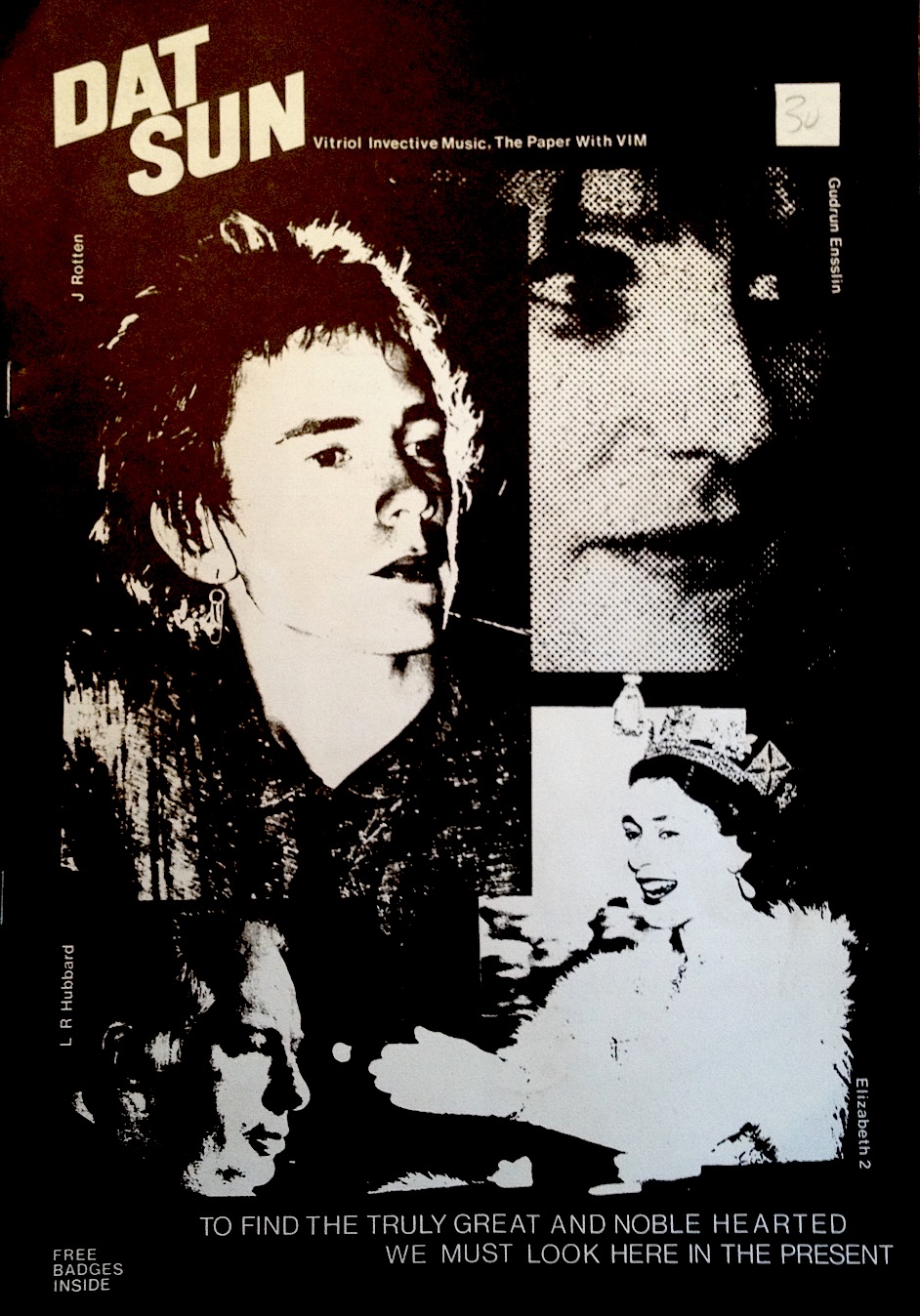
Found in a scarce 1977 punk fanzine Dat Sun which also has a Wyndham Lewis inspired 6 page 'Blast' against current stuff. Anonymous*. It covers the last (or penultimate) appearance of the group on British soil at Cromer, Norfolk on Christmas Eve 1977 (punk's annus mirabilis.)

God rest you merry gentlemen in a quarter of an hour the Sex Pistols will play. We slip into the Links pavilion and buy tickets - easier than the village dance. Due to slippery disputes and reports of cancellation in the East Anglian they had not sold out. Dub Disco falls heavily on country in years, 75% East Anglian punks. Johnny Rotten in fashionably squashed pith pelmet surveys the audience critically from the balcony : Sid Vicious tries on T-shirts. The audience is a bit shy of them, and pretends it hasn't noticed. There is no mystique about the boys arriving in a limo or helicopter at the last big moment - the group are, it seems, actually waiting for everyone to turn up before they play.

Monday, February 4, 2013

I once met...The Clash

I once met The Clash. It was the summer of 1977, the year of Punk. Somehow I knew the roadie of the Sex Pistols who was known as Boogie (as in 'book' not 'boon') - later he became an art dealer like his father and I rented him a gallery, back then his flat near Bell Street (many bookshops there then) was always full of punk musos inc Malcolm McLaren, Bernie Rhodes - I even saw Vivienne Westwood there once.

I recall meeting the whole of The Clash there once, they were standing about in zipped and paint spattered clothes. They were off to the West End and wanted to know the way to Shaftesbury Avenue. As there were 5 of them (for some reason they had Steve Jones of the Sex Pistols with them) I suggested they just get a cab. Joe Strummer's reaction was interesting he said 'No cabs. We'll walk there, we're in love with life.' His voice was vaguely middle class, something he didn't bother to hide. I liked him. That's it.