Showing posts with label Journalism. Show all posts

Saturday, December 5, 2015

Fashionistas (1789)

Found - a scrapbook of press-cuttings mostly from the Irish newspaper the Cork Gazette. This cutting dates from about 1789. They are mostly taken up with oddities, strange wagers (can a walking man cover 20 miles faster than a walking horse?*) horrible executions, feats, obituaries, a letter from Dean Swift, marriages of royals etc., This piece about current extreme fashions is an example of the  slightly sensational journalism of the time…

Fashion

This most whimsical of all human inventions has undergone, within these few years the most unaccountable changes imaginable, nor is she yet at rest but, with Protean wantonness, every day affirms the new form, leaving a gaping world in pursuit of her. One no sooner catches her, than she escapes, then presents herself under a different form, still more seducing and irresistible than the former.

One time she lets her head grow to the length of a cows tail, then cocks it - it sometimes flows loosely, and others nicely plaited and made into tresses - she soon prides in frizzing, and after that falls down by the ears, hanging like a pound of candles - her  present frolic is a crop, which for aught we know be soon metamorphosed into a shorn head. 

This Dame puts her hat  into a thousand  forms

Sunday, November 1, 2015

Literary scams and pitfalls(1906)

Found in The Fingerpost: A Guide to Professions for Educated Women, with Information as to Necessary Training (Central Bureau for the Employment of Women. 1906) an article called 'Literary Catchpennies' which outlines various scams played on would be writers of the time. Some of these scams, often for bigger stakes, are still with us on the web.

Literary Catchpennies

The perennial literary advertisement trick is, perhaps, the most specious of all. A "Publishing Firm" will offer to consider MSS. sent to Box so-and-so at the offices of the paper in which the advertisements appears. Or the advertisement asks for some specified requires a fee; sometimes he merely swallows all the MSS. sent to him and is heard of no more. A plausible gentleman, with an office in London, extracted from a struggling authoress of my acquaintance a fee of 10s. 6d. for the purpose of making copies of a little tale of hers for the American Press.

Sunday, October 18, 2015

Amateur Journalism and Vanity Publishing (1880)

Found - Journals and Journalism (with a guide for literary beginners) published by the Leadenhall Press (London 1880.) The author is stated as 'John Oldcastle' - a pseudonym of Wilfrid Meynell (1852-1948) who became a newspaper publisher and editor. It is likely that the book appeared because at the time journalism was all the rage, like photography in the 1960s or developing apps now…It is full of good advice, occasionally caustic in tone, and starts out with a warning to 'amateurs'. The final part of this extract from the first chapter deals with vanity publishing scams, and refers to an amusing scandal when one scammer sued another. These 'bubbles' were then common and are still with us on the internet. The entire text can be found at Brewster Kahle's incredible expanding Internet Archive.

Even more fatally amateurish is the practice, not uncommon with beginners, of addressing a more or less gushing note to an editor, disclaiming any wish for remuneration, and intimating that the honour of appearing in his valuable paper is all the reward that is asked. A contribution that is worth printing is worth paying for; and to an established paper the trifling sum due for any ordinary article is a matter of no consequence whatever — a mere drop in the bucket

Monday, September 28, 2015

"GOING! Going! Gone!"

Found - an obscure work by Robert Power, a forgotten journalist. In the 1920s and up to the early 1950s his short 'thought pieces' were syndicated in the UK and as far as Australia. This tradition of coffee break columns is still with us - now it's Robert Crampton rather than Robert Power but it may not continue much longer…There is no real equivalent online. This is from his Two-minute talks (Vol 2)  S. W. Partridge (London,1925) and still has some relevance in the time of eBay. Other 'talks' have titles such as 'Poppy Friendships', 'Blistering Tongues', 'In the W.P.B.', 'Rich Poverty', 'Are you Popular?', 'Poachers' and 'Rubbernecks.'

"GOING! GOING!"

"GOING! Going! Gone!" cries the auctioneer and brings down his mallet with a sharp rap to declare that opportunity to purchase has passed for all save the highest bidder.

The auctioneer emphasises the desirability of the goods he offers. In seductive language he paints the picture of a bargain that must be seized at once. Prudence struggles with desire in the mind of the keen bargain hunter,

Friday, September 18, 2015

James Greenwood (1832-1929) A Janus of Journalism

Found at the front of a book catalogue ('Chat Dept.') of  J.J. Rigden from the Haining collection this well researched piece on Victorian journalist James Greenwood.

James Greenwood (1832-1929) A Janus of Journalism

This author is now a little better known than he was a few years ago. He contributed to the world of boy's books, some exciting, though bloodthirsty works of fiction that can still be avidly read today.

Relying on his experience as a sensational journalist, he leaned heavily on the plot. His charters were not much more than 'cardboard cut-outs', and to a certain extent, he seemed to be obsessed with lycanthropy. 'The Bear King' 1868, 'Purgatory of Peter the Cruel' 1868, 'Adventures of Seven Footed Foresters' 1865… all have shape-changing as a major theme. His descriptions of blood-letting in various forms were highly coloured, leaving very little to the imagination.

Yet, this was the man, who in 1874, published a vitriolic attack on the penny-dreadfuls, their publishers, authors and distributors, (Wilds of London, Chatto 1974). He described the papers as 'penny packets of poison', corrupting the minds of the young and laying the prevalence of all types of crime at their door… (Much the same today with horror films and comics, does nothing change?) As to the distributors, he was at pains to point out that they were greedy and unscrupulous.

Tuesday, September 8, 2015

Smatterers or Scholars?

Found - an obscure book by a forgotten journalist. In the 1920s and up to the early 1950s his short 'thought pieces' were syndicated in the UK and as far as Australia. This tradition of coffee break columns is still with us - now it's Robert Crampton rather than Robert Power. His ideas are oddly prescient given the plethora of information now available. The answer to the second part of Dr Johnson's question is known by everybody - and it's not the Encyclopaedia Britannica! This is from Two-minute talks. Second volume. Robert Power. London: S. W. Partridge [1925] pp.45-46.Other 'talks' have titles such as 'Poppy Friendships', 'Blistering Tongues', 'In the W.P.B.', 'Rich Poverty', 'Are you Popular?', 'Poachers' and 'Rubbernecks.'

Smatterers.

Time was when we used the word "smack" to mean "taste," and thus a taster became known as a "smacker". It is not difficult for a generation of slovenly talkers to corrupt a word, and thus "smacker" or taster has become "smatterer," one who has only a slight, superficial knowledge, a sciolist.

It is a pity that we have not a more handy word to describe such people, for they are very numerous in this age. Perhaps this multiplicity is due to the fact that there are now so many things about which one is expected to know something. Perhaps it is becoming impossible to be a scholar, and that we can hope, at best, to be only a superior smattered.

I trust not.

There is no disgrace in being a smatterer if one has not had an opportunity of becoming a scholar. The taut arises when a smatterer thinks he is a profound scholar, and behaves accordingly.

Old Dr. Johnson laid it down that knowledge is of two kinds - either we know a thing, or we know where we can obtain information about it.

Saturday, July 18, 2015

Disability ! What disability ? The Amazing Constance Smedley

In her sixty six years Constance Smedley (1875 - 1941) managed to pack more into her life than most centenarians would do. Despite being on crutches from her early years and confined from her thirties to a wheelchair (due to some unidentified disability, possibly a hip problem) this Birmingham-born fireball, who married the gay artist Maxwell Armfield, was at various times a crusading feminist, suffragist  and journalist, an artist,  novelist, playwright, organiser of pageants and folk dances, and perhaps most notably, the founder of the world’s first arts and science club devoted entirely to women.
It is on the notepaper of the London-based Lyceum Club, which the twenty-eight  year old Smedley helped to found in 1903, that this featured letter (below) also shows her to be a tireless encourager of talent among women—especially budding musicians and actresses. Here she writes to an actress and fellow feminist Annie Schletter,

Thursday, January 8, 2015

Wickham Steed

Wickham Steed
(Bibliotheque Nationale Francaise)
[L.R. Reeve* writes:] Somewhere in the world of books there must surely be a biography of the late Wickham Steed. He would have been an eminent man if only for his vast knowledge of foreign languages: a knowledge which could be acquired only after months and years of intense application to his studies and excellent hours.

One wonders whether his obvious passion for other tongues began at the Sudbury Grammar School. Did he learn from an enthusiastic and efficient French teacher, or was his enthusiasm inborn in spite of an apathetic form master?  No matter. His enthusiasm and obvious genius could never develop so remarkably without both inherent ability and uncommon will power. No indolent man could have achieved so much. His long arduous apprenticeship abroad began, I fancy, at the Sorbonne, in Paris. When he spoke to a large audience on foreign languages at Essex Hall, Strand, he told us of a Parisian who informed him that he spoke French like a Frenchman: a testimony which all students would like to hear.


Saturday, June 21, 2014

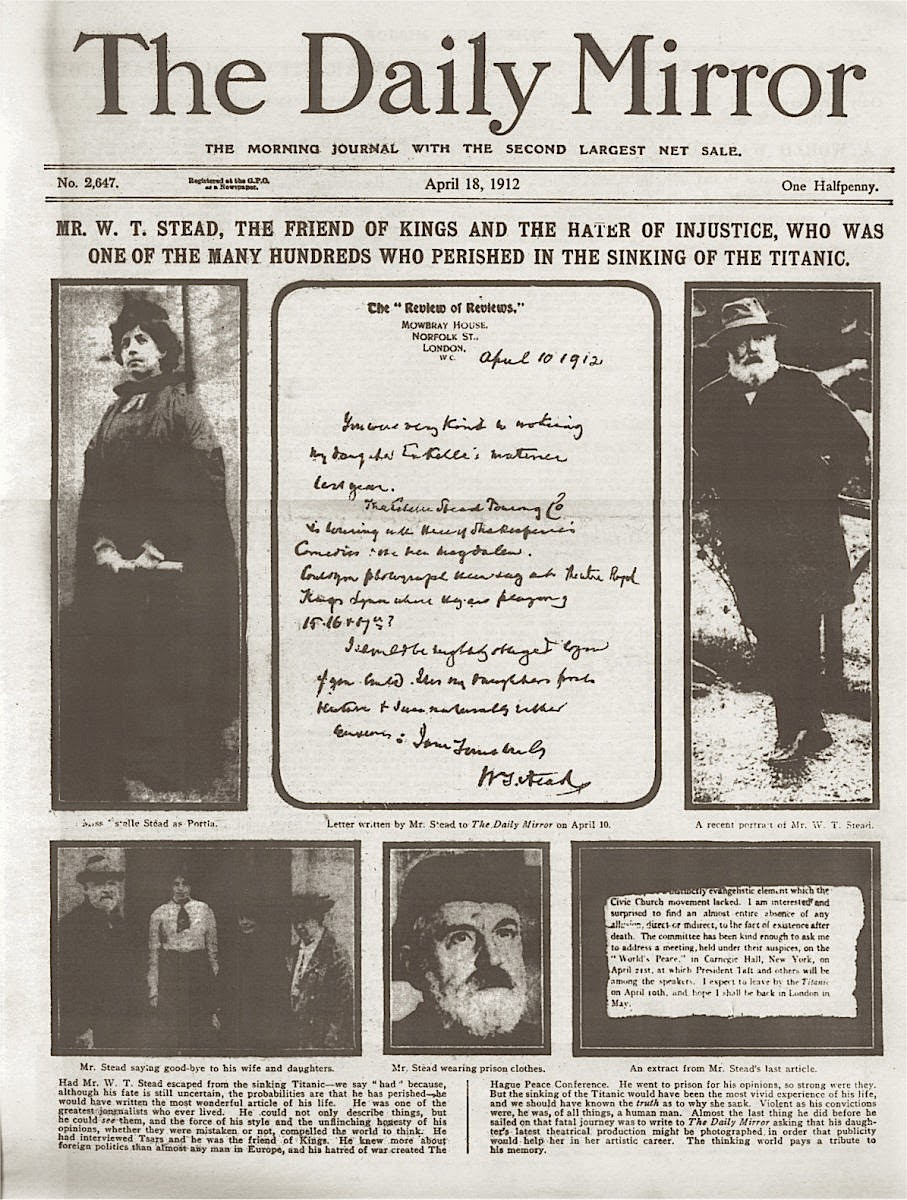
W. T. Stead - a message from the Titanic & the after-life

Found - a rare booklet published in Melbourne, Australia circa 1913 -What Life in the Spirit World Really is. Being messages received from beyond the veil by Annie Bright. It is purportedly by the great newspaperman W.T. Stead (1849 - 1912) who had drowned in the 1912 Titanic disaster. It was  in fact 'channelled' from Stead by one Annie Bright. Stead numbered spiritualism among his many interests and as well as editing The Pall Mall Gazette (which became the Evening Standard) he also edited the occult quarterly Borderland. He is said to be the first 'investigative journalist' and campaigned against child prostitution and the London slums. He befriended the feminist Josephine Butler and joined a campaign with her to successfully repeal the Contagious Diseases Act. He was an early Esperantist and he is also the father of modern paperback publishing and even 'digest' publishing, issuing severely abridged versions of the classics. Wikipedia has this to say of his last moments on the Titanic:

After the ship struck the iceberg, Stead helped several women and children into the lifeboats, in an act "typical of his generosity, courage, and humanity", and gave his life jacket to another passenger.
A later sighting of Stead, by survivor Philip Mock, has him clinging to a raft with John Jacob Astor IV. "Their feet became frozen," reported Mock, "and they were compelled to release their hold. Both were drowned." William Stead's body was not recovered. Further tragedy was added by the widely held belief that he was due to be awarded the Nobel Peace that same year.


In this 1913 booklet there is a message from him a week after his drowning blaming the greed of the companies who try to break speed records crossing the Atlantic...the messages came through automatic writing (one of Stead's interests) via one Julia of a spiritualist gazette called The Harbinger:

I am now in a position to know some of the eternal truths of Spiritualism. The terrible accident had nothing in it of a terrible nature for myself. My only sorrow was for the despair and mental terror, as well as the physical suffering

Friday, March 21, 2014

Chiff - Chaffs in March


Found -- a couple of pages from a magazine loosely inserted in a bird-spotter's book. They are from 1967 and seem to me from a magazine about or sponsored by PNEU -the Parents’ National Education Union -an affiliation of  schools throughout the British Isles and the world**. In an article  by Dinah Lawrence* a freelance journalist and novelist she discusses wild life in March. The style is reminiscent of the nature notes still found in The Guardian and gently parodied by Evelyn Waugh as long ago as 1938 in Scoop. After discussing Jung and Freud Dinah Lawrence talks about Professor Hardy's recent Gifford Lectures which, as in his book The Living Stream, make a link between Natural History and religion.... she then discusses bird life:


I start listening for Chif -chaffs about the middle of March. I have only heard their light, non-carrying voices once as early as 6th March. I also go to a friend's land,  well  before the end of the month, to see if the Sand-martins have arrived  at her huge sandpit. They seem to start work straightaway, even after their long journeys, for the birds that roost in the reeds in the valley nearby, do seem to be the birds that are going on, farther north. The activity of digging out holes for nesting places is a fascinating operation to watch. The steep faces of the sandpit are pocked with old ones and these feathery-legged birds sometimes clear these and sometimes start new ones. If you stand below on the floor of the sandpit, little jets of sand puff out from old and new holes: the birds scuff the sand out with their feet, as they go burrowing in, head first.

Sunday, December 8, 2013

Mortimer on British Class System 1969

A typed signed manuscript with ink corrections by Raymond Mortimer and a typed signed letter of rejection from the then Sunday Times editor Harold Evans.

Mortimer's article is now somewhat outdated, although a class system still exists in Britain. 'The Nobility' has now been largely replaced by celebrities and there is now, as in America, a much greater emphasis on money. It seems at the time the Sunday Times was running a series of articles on class by well known writers.


April 18th, 1969

Mr. Raymond Mortimer, CBE,
5 Canonbury Place,
LONDON N.1.

Dear Raymond,

  I'm sorry that I agree with you that I don't think it is quite pointed enough. I think it would need to have some specific symbols of class. The Snowdon observation about class and motoring is the sort of thing I mean:

Saloon car with two husbands in front, their two wives behind = lower class.

Ditto with mixed couples in front and back = middle class.

Ditto with no one in back, husband and somebody elses wife in front = upper class.

  I leave it to you whether you feel you want to do any more work - I'm sure there is a piece here - and I'm grateful for you response. Your sincerely Harold Evans. Editor. 

[Mortimer article]  "Why, " I was asked by a friend half my age, "Do you say that there are at least nine classes in England?" Well, I also denied the existence of any frontiers between them, and it might be nearer the mark to say eighteen, because each class can roughly be divided into those who were born in it and those who were not. The subject in any case has become a joke and an embarrassment, as sex was in the Victorian Age. We avert our eyes when class "rears its ugly head"-- and may even believe that distinctions of class no longer exist, apart from differences in education, occupation and income. This seems to me wishful thinking, although the young today are not nearly so class-conscious as their grandparents.

  The various classes are difficult to define or enumerate, because they often depend upon social habits-- tastes in food, drink, dress and pastimes, for instance, and ways of speech, both in vocabulary and accent. The ninefold division (derived from social historians, biographers and novelists, not from sociologists,) cannot be trusted because it is mainly based upon rank or occupation. All reserves made, here are the nine. A. Royalty; B. The Nobility; C. The Landed Gentry; D. The Upper Middle class; E. The Solid Middle Class. F; White-collared workers. G. Lower Middle Class (small shopkeepers, for instance); H. Skilled Workers; I. Unskilled Workers. (That use of the words "worker" or "working class" is unhappy, because it implies that other classes are idle.) Each of these classes merges into others.

  Members of A. marry into B., C, or even D.