Showing posts with label Theatre. Show all posts

Thursday, September 24, 2015

The irresistible Samuel Foote

Found- in the The common-place book of literary curiosities, remarkable customs, historical and domestic anecdotes, and etymological scraps by Rev. Dr. Dryasdust, of York. (London: John Bumpus 1825) these amusing anecdotes about Samuel Foote (1720 – 1777) the British dramatist, comic actor and theatre manager. Probably the best known quotation associated with him is a put down of an unnamed 'law lord'. Foote said of him- 'What can he mean by coming among us? He is not only dull himself, but the cause of dullness in others.' Dr. Dryasdust provides six anecdotes about Foote. The first concerns Samuel Johnson, who tried very hard not to be amused by him..the last, where he messes up his lines in Hamlet, has the spirit of Tommy Cooper or Stanley Unwin. His Othello was apparently a 'masterpiece of burlesque..'

1. Life's a poor player.

"Dr Johnshon said, 'The first time I was in company with Foote, was at Fitzherbert's. Having no good opinion of the fellow, I was resolved not to be pleased; and it is very difficult to please a man against his will. I went on eating my dinner pretty sullenly, affecting not to mind him; but the dog became so irresistibly comic, that I was obliged to lay down my knife and fork, throw myself back in my chair, and fairly laugh out. Sir, he was irresistible!"

Thursday, August 20, 2015

Young England - the worst play ever?


Found - a 1935 theatre programme for Young England, a play by Walter Reynolds often cited as the worst play ever. Nevertheless it was a great success and some people saw it 20 times. We covered it pretty thoroughly at a posting at bibliophile site Bookride. We had found a copy of the book and catalogued it thus:
Young England is a now uncommon book  and of interest to theatre collectors and connoisseurs of the odd and the zany. Reynolds appears to have been a sort of Amanda Ros of the theatre--so very bad that he is good. Young England (Walter Reynolds) Gollancz, London 1935.  8vo. pp 288. Frontis portrait, 5 plates. A play in two periods. This play had an unlikely success in the 1930s rather similar to the fictitious 'Springtime for Hitler.' It was so appallingly bad that audiences came along in their droves for over 300 nights to shout amusing remarks and generally revel in its ghastliness. The frontis portrait of the Reverend Walter Reynolds shows a stern Scottish type who apparently would walk up and down the aisles of the theatre during performances telling people to be quiet. Quite scarce.'

What emerges from contemporary reviews is that the actors in this terrible play co-operated with the audience and adapted lines and action according to shouts from the audience, some of whom were fuelled by cocktails which were so popular in the 1930s…In one performance the villain, when led away by the police, pauses to say "Foiled!" He was almost licked one night when the crowd shouted not only "Foiled!" but "Baffled!" "Beaten!" "Frustrated!" "Outwitted!" "Trapped!" "Flummoxed!" He waited until the wits were through, then hissed: "Stymied!"

Tuesday, September 2, 2014

John Osborne observed in 1959

Reading Which of Us Two? The Story of a Love Affair (Viking, London 1990).It is the record of a 'youthful, illicit and intense' relationship between John Tasker (1933 – 1988) the theatre director and Colin Spencer (born 1933) artist and writer. Spencer uses a  collection of letters the lovers wrote to each other (his were returned after John Tasker's death) and considers the relationship and why he 'murdered its future'. Spencer makes acute and amusing comments on literary figures including John Osborne (whose library we bought last year). This entry was starred by Osborne in his copy:

 17.iii. 59. Yesterday I began drawing the great Mr Osborne, tall, thin, spectral: in black skin-tight trousers that showed a cute bottom and a huge lunch. And camp, my dear – not 'arf.  And the musical, my dear, cor that's a queer dish too, everybody changes their sex halfway through and deliciously lovely Adrienne Corri grows hair on her chest. Most peculiar: he was moving about so much, it's only the second week of rehearsals...though I did some lightning things with a brush, it just won't do so I'm going back after Easter and try some more. He has a curiously camp voice and he appears to stare at one with his teeth...

Colin Spencer says of this letter:

The John Osborne musical was of course The World of Paul Slickey, soon to become the only commercial failure of his early years. [We]admired Look Back in Anger, our generation felt that Osborne encapsulated the rage

Friday, May 9, 2014

Making up is hard to do

A rare pamphlet (there is only one for sale on Abebooks), The Secrets of Making-Up, co-edited  by two old stagers, J. Ainsley Brough and George M Slater, is 70 pages of very useful advice on how to transform yourself into anything from a man of ninety to an octoroon. It seems to date from around 1922, but for some reason a typeface is adopted that was current c 1903. There are some wonderful photos of actors from the Music Hall and Revue, all demonstrating the transformative powers of grease paint and powder.

Although politically very much of its time (the N word is one of a number of dubious references), essentially this is a practical and modern guide. The humour—especially in a lively article on Revue and Vaudeville by Slater ( 1870 – 1949), a theatre manager and prolific writer of pantomimes, whose archive is now at the V & A—is genuinely funny, even slightly ribald. The ads at the back also contribute much to modern theatrical history.

Some tips:
1) An actor should ideally shave off his moustache, not cover it with 'goldbeater’s skin' , whatever that is,  if portraying a clean shaven person.
2) Stage Character make-up is useless for film work, and when wigs are used they must on no account have a ‘scalp join’ . No explanation is offered.
3) When portraying a Chinese or Japanese person, 'do not line under the eyes, as Chinese and Japanese have small eyes’. [RR]

Wednesday, February 5, 2014

The Princess and the Pauper---seeing is not always believing

Sent in by loyal jotperson RMH. It is worth noting that despite his suggestion HG is not totally forgotten and, in fact, is quite saleable. He was also, at one time, collected by Teflon man Kenneth Baker and other lesser lights...


Here’s a puzzle. Look at the cover of this oddity recovered from a job lot two years ago. Open the volume and seemingly, what we have is the printed programme notes of a comic drama performed at ‘The Theatre Royal’, somewhere or other, bound in with a carbon copy of the script. Looking more closely we find that the venue is Government House and the reviews, which are from Canadian newspapers mainly from the Ottawa district, are far too facetious to have been genuine. Further research reveals that, despite the highly professional quality of the programme, everything suggests that the ‘extravaganza’ is purely an amateur production. A little more delving tells us that most of the players are members of the same aristocratic family—in fact sons and daughters  of the fourth Earl of Minto, Governor General of Canada, then a British colony.

We have already noted that the playwright was ‘Col. D Streamer’ and the small print reveals that this supposed army officer (who also directed the play) was the author of Ruthless Rhymes for Heartless Homes, which had appeared a year before the play was performed. By now, most fans of ‘sick’ humour will have twigged that Col. D Streamer was the pseudonym of one of Britain’s most admired comic poets--a man worthy to stand by Thomas Hood and Edward Lear-- much darker than the former and just as inventive as the latter. We are talking, of course, about Harry Graham, then just 26, who was aide de camp to Lord Minto and a close friend of the Minto family (pic below).


The Governor General and Graham, who were both old Etonians, got on famously, but it is not known what his employer thought of such a ‘ruthless rhyme’ as the following: 

Billy, in one of his nice new sashes
Fell in the fire and was burnt to ashes
Now, although the room grows chilly
I haven’t the heart to poke poor Billy   

However, it is likely that Minto took the play’s rather disparaging references to Canada, and Ottawa in particular, in good heart. In his turn Graham had the script ( which was probably his own )and accompanying programme notes specially bound and presented to Lady Minto at Christmas, 1900, possibly just after the play hit the Theatre Royal. Incidentally, this grandiose- sounding venue was probably just a modest lecture hall within Government House, specially adapted for this one performance by family and friends.

In the following year Graham departed for the Boer War. He returned unscathed in 1902 for a second term as Lord Minto’s right hand man. Before his death in 1936 he went on to publish more comic verse  and compose many more comic dramas, most of which, like The Princess and the Pauper,  are now totally forgotten. 

Sunday, April 14, 2013

National Front versus Calder & Boyars + 'corruption and depravity' 1968

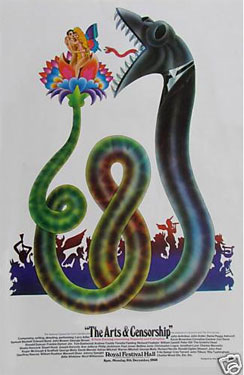
 From a collection of political ephemera. A note attached to an ordinary paper bag which was intended as a sick bag. A protest at a performance at the Royal Festival Hall in 1968 The arts and censorship : a Gala Evening concerning depravity and corruption. Put on by 'The National Council for Civil Liberties and Defence of Literature and the Arts Society', this was a performance involving, among others, Alexander Trocchi and Samuel Beckett. It was  compered by George Melly and with contributions, performance, material or both by  John Mortimer, Roger McGough, The Scaffold, Larry Adler, Fritz Spiegl, Edward Bond, Willie Rushton, Marty Feldman, Barry Took, Billie Whitelaw, Christopher Logue, Adrian Mitchell, Sheila Hancock, Tom Lehrer, Ann Firbank, Paul Jones, William Burroughs, Bertolt Brecht & Dame Peggy Ashcroft.

 Copies of the programme are to be found in distinguished American libraries with the vomit bag and statement laid in. The cover for the night's programme was by Alan Aldridge and his poster for the event is shown below.

The National Front is a far right UK political party. In the 2010 general election they garnered 0.6% of the vote.


VOMIT IS VALID!

This paper bag is presented to you with the compliments of 

****THE NATIONAL FRONT****

We are sure that the most 'avant-garde',  pseudo-communist, drug addicted sex perverts will feel impelled to vomit before the evening's exhibition of "corruption and depravity" is over.

But don't waste your vomit by throwing it at the performers. Instead, store your vomit in the paper bag and give it to Mr John Caldar will Miss Marian Boyars as you leave. These well-known "publishers" will welcome your personal contribution to their forthcoming book : "Gillie de Retz - Saint, Social Reformer and Martyr."

Thank you for your co-operation.

Printed and published by the National Front 11 Palace Chambers, Bridge Street, London SW1. 


There is no trace of the Calder and Boyars book and it appears not to have been published.

Gilles de Montmorency-Laval (also known as Gilles de Retz or Gilles de Rais) (1404–1440), Baron de Rais, was a Breton knight, a leader in the French army and a companion-in-arms of Joan of Arc.

From 1427 to 1435, he served as a commander in the Royal Army, and fought alongside Joan of Arc against the English and their Burgundian allies during the 100 Years' War, for which he was appointed Marshal of France.

In 1434/1435, he retired from military life, depleted his wealth by staging an extravagant theatrical spectacle of his own composition and dabbled in the occult. After 1432 Gilles engaged in a series of child murders, his victims possibly numbering in the hundreds.

He is believed to be the inspiration for the 1697 fairy tale "Bluebeard" by Charles Perrault. His life is the subject of several modern novels, and referenced in a number of rock bands' albums and songs.

Saturday, February 2, 2013

I Hate Producers! (James Mason)

Found in the UK mag Lilliput of April 1946. James Mason's response to recent Ben Hecht book I Hate Actors. A great actor and the best Humbert Humbert so far...look out for his coinage 'hambaiting' in paragraph 5.

  EVERYONE says that Walt Disney is the happiest producer in Hollywood because he does not have to put up with actors around his studio. Further evidence is to be found in in the title page of Ben Hecht's recent book "I Hate Actors." And I am prepared to testify that the feeling therein expressed is by no means peculiar to Hollywood.
  The abhorrence that flickers in a film producer's eye when the sanctity of his script or the ability of his pet director is rashly questioned by an actor is an awesome vision. It is as if the gates of hell swing open.
  For this reason I would recommend to this branch of our art only those aspirants who have exceptional resilience. Those without it are a prey to duodenal ulcers and persecution mania. For tho' the hatred may be mutual the struggle is unequal.
  The average producer's civility towards an actor extends only to the moment when the contract is signed. He is a skillful coaxer, all teeth and cigars, and even permits himself to say nice things about the fellow's acting in an effort to ingratiate. Then, almost before the ink is dry, he seems to say "O.K. We've got his signature. Now let's give him hell."

Monday, January 21, 2013

Theatre programme for Simon Gray's Cell Mates


The original  1995 theatre programme for the short-lived Albery Theatre's production of Cell Mates signed by cast member Stephen Fry. The play also starred Rik Mayall. It has 36 pages.

Fry's involvement - or rather, almost immediate non-involvement - in the production was the focus of much media rumpus at the time, although he now recalls the episode with philosophical good humour. The whole episode is covered elsewhere in some detail and the playwright Simon Gray later published an account of events in his diary, Fat Chance.