Showing posts with label Politics. Show all posts

Friday, June 5, 2015

David Lloyd George


From the papers of L.R. Reeve*. His account of a major figure, much chronicled elsewhere, but with some unique insights as Reeve saw him speak many times, even in parliament.

DAVID LLOYD GEORGE

In some ways Lloyd George is a difficult subject, as so many people have heard the same stories from various sources, there is always the possibility that many have been heard on previous occasions.
I heard him first, in the House of Commons during the First World War, and unexpectedly the topic under discussion was an increase in the charges for alcoholic drinks. I remember little about the speeches except that prices would be increased for the miner who wanted to wash down the coal-dust with many libations, and that for the purposes of the Act Guinness would be in the same category as beer.
Lloyd George was unhurried, spoke well without interruption, to a small attendance of quiet members who were later on somewhat roused, when a Scottish brewer Sir George Younger**, rose and made a really fluent speech which interested me more than any other contribution during that session.

Tuesday, June 2, 2015

Lord Haldane

Found among the Reeve* papers this short memoir of Lord Haldane - i.e. Richard Burdon Haldane, 1st Viscount Haldane KT, OM, PC, KC, FRS, FBA, FSA (1856 – 1928)  an influential British Liberal Imperialist and later Labour politician, lawyer and philosopher. As with many of Reeve's pieces he had never met the man but had seen him give speeches at congresses and describes his speaking style well. He writes '...many have known have not known me. All of them I have seen, most of them I have heard, and some of them have sought information, even advice from me." For Reeve the unifying qualification all these people have is '… some subtle emanation of personality we call leadership, and which can inspire people to actions  unlikely to be undertaken unless prompted by a stronger will.'

LORD HALDANE

When one begins to delve into the pages of great books of reference, such as the Encyclopaedia Britannica, there are times one stops at a certain page and reads with an increasing sense of wonder and respect. I was looking for Haldane, and as I read the wonder grew. So this was the man treated so contemptuously by most of us during the First World War!
I claim no laurels for being among the minority when the bitter controversy was in full flood, for I knew many with a similar opinion. Asquith’s "Wait and See" caused one of the most ridiculous slogans in my memory;

Dr. Alfred Salter

Statue of Dr. Salter in Bermondsey
Found among the Reeve* papers this portrait of Dr. Alfred Salter (1873 - 1945) medical doctor and Labour politician - still famous in Bermondsey - as Reeve says he was 'the salt of the earth…'

DOCTOR ALFRED SALTER

Fenner Brockway says that Dr Salter was the most brilliant medical student of his time. He could have had a nameplate proudly displayed in Harley Street, and ended his days a wealthy, outstanding medical practitioner welcomed by the affluent anywhere he sought his leisure moments. Instead he installed his surgery among the somewhat turbulent extroverts of Bermondsey, where the underprivileged masses suffered a shortage of skilful medical talent; and although the borough's alcoholic content may be proportionately higher than many places in England, throughout the district a sense of rightness, perhaps even a touch of gratitude exists for the services of a man whom people knew was a genuine servant of mankind. The dockers, usually fond of their pints, returned to parliament again and again, an ardent teetotaler who loved his fellow men. Bermondsey is like that.

Tuesday, February 17, 2015

Gladstone at Dollis Hill


One of the most crass and insensitive planning decisions made in 2012 was the demolition of Dollis Hill House in NW London. The fact that this semi-ruinous building, which began as a farmhouse in 1825, was once the country retreat of four-times Prime Minister William Gladstone and the home for a while of American novelist Mark Twain, couldn’t  save it from the philistines on Brent Council or, for that matter English Heritage. It has been argued that too much money was required for its restoration and back in the middle of the post 2009 recession, no entrepreneur was willing to come forward with a viable plan. A museum with a cafĂ© or restaurant attached would have been a perfect use for this building. As it is, Dollis Hill Park now has a razed platform where the historic house once stood, and although there are plans for some sort of reproduction of Gladstone’s bolt hole, it is  not, dare I say, quite the same…

On the evening of 3 May 1892 the G.O.M of Victorian politics once more left his home at Carlton Gardens, in the heart of Westminster, for Dollis Hill House. Just before his departure he wrote the following letter (discovered in a collection of autographs) to a friend, possibly Lord Rendel, an old Liberal comrade.

I send herewith the Life of Manning. He was Roman, and he was ultra Roman : no man more so. But he was a great Christian, in respect of detachment from the world,

Wednesday, February 4, 2015

The Worst Government for 100 years?

This rant on Harold Wilson's Labour Government came from the Wells (Somerset) Conservative Association. It was a one page flyer printed in blue ink and had first appeared in The Daily Telegraph. Anthony Lejeune, a highly competent journalist and author is not gifted with a Wikipedia page but there are traces of his career from a search on the site. He wrote a history of London clubs and has written about Arthur Machen and Fr. Brocard Sewell. He has written about Ernest Bramah in The Tablet which may mean he is a Catholic and almost certainly a book collector…the piece (very slightly  truncated) is very much of its time (circa 1966). Politicians are no longer condemned for wearing the wrong clothes at parties.

The Worst Government for 100 years? by Anthony Lejeune.
Do you remember George Brown on television, flanked by leaders of industry and the trade unions, flourishing his fatuous Declaration of Intent? Do you remember the commentators solemnly telling us that this marked a watershed in the history of British industrial relations? And do you remember any of those commentators apologising to us since for having been taken in by so naive a piece of nonsense? I don't.

Do you remember the National Plan?
I got into trouble with the BBC for treating it, the week it was published, with the disrespect which it soon proved to deserve. I'm still waiting for an apology or even an admission that I was right.
From Private Eye

Have we heard an apology from those who scoffed at predictions that a Socialist Government would mean big tax increases and that "voluntary" wage restraint would soon be followed by compulsory wage restraint? Have we, indeed, heard many apologies from the middle-class voters who argued blandly that a spell of Labour Government would "do no harm"?

We have not. All these people seem as reluctant to admit they were wrong as Mr Wilson himself.

But there is surely cause for apology. The plethora of troubles and distances into which we have been plunged since that black Election Day in the autumn of 1964 ought not to have taken any intelligent person by surprise. They were fully predictable and were, in fact, fully predicted.

Thursday, January 15, 2015

H.H. Asquith (Earl of Oxford & Asquith)

[More from the papers of L.R. Reeve* who writes:] I remember, somewhere around 1907, reading a wrong prognostication in a Manchester newspaper, the 'Daily Despatch', about Lloyd George, Grey, Runciman, McKenna, Birrell, Samuel, Haldane, Morley and Winston Churchill.

Nine names of nine outstanding men who, under Henry Herbert Asquith, formed one of England's strongest cabinets ever known. The cabinet was so powerful, said the prophetic journalist, that Asquith might never be able to control so formidable a group of parliamentarians. We all of course know that he did, and that by 1914 some far -reaching acts of parliament had been passed by the government.

One of the early acts, causing the lengthy, bitter 'ninepence for fourpence' controversy and angry snarls about stamp-licking can never be forgotten by octogenarians, and I cannot believe that widespread antagonism towards individual members of parliament today is as vindictive as that of my young days; and as yet parliament hasn't witnessed the unprecedented scene encountered by Asquith when he rose to speak on the bill abolishing the veto of the House of Lords. For nearly an hour he stood almost unheard against the continuous roar of anger from the opposition. Finally he sat down defeated by the pandemonium. Later the incident was known as 'the Pothouse Brawl'.

Sunday, August 17, 2014

Auberon Herbert poet and voluntaryist


Found in Windfall and Waterfall (Williams & Norgate, London 1894) a volume of poetry by Auberon Herbert  - an advertisement for his journal The Free Life - the organ of Voluntaryism. Auberon Edward William Molyneux Herbert (Highclere, 18 June 1838 – 5 November 1906) was a writer,poet, theorist, philosopher, and 19th century individualist. A member of the Parliament of the United Kingdom, Herbert was the son of the 3rd Earl of Carnarvon, brother of Henry Herbert, the 4th Earl, and father of the 9th Baron Lucas. He promoted a classical liberal philosophy and took the ideas of Herbert Spencer a stage further by advocating voluntary-funded government that uses force only in defence of individual liberty and private property. He is known as the originator of voluntaryism.
The poetry is competent and clean limbed, somewhat of its time but counter to the prevailing decadence of much 1890s verse. We are quoting the tract on voluntaryism and preceding it with a couple of poems. His ideas are still alive, especially in the libertarian fringes of American republican thinking...


THE UNKNOWN SHORE. 
It falls on my ear, now faint, now strong, 
The thunderous note of the distant roar, 

The surf of the sea I have sailed so long - , 
As it beats at last on the unknown shore. 

Oh ! how will it be, when the hour has come,- 
Unlike all hours that went before, — 

Will help be near, or in pain and fear, 

Shall I win my way to the unknown shore ? 


IN BORDERLAND. 
For strange deep longings move us, 
As betwixt the two we stand, 

And share in the mystic meetings 
And partings in borderland ; 

When day and night so gently 
Touch hands, and fall apart, 

Like those in life forbidden, 

Heart should be one with heart. 

THE FREE LIFE

Organ of Voluntary Taxation and of the Voluntary State ; 
Edited by Auberon Herbert. Id. Monthly. 

'"THE FREE LIFE does not believe in creating happiness, virtue, or prosperity for the human race by Acts of Parliament. It does not believe in splitting the nation up into two or three political parties, each trying to vote down the other, and to force upon the other its own opinions and interests. It does not believe in the modern politician, always engaged in glorifying himself and his party,

Tuesday, June 10, 2014

The McWhirters v. the unions (1974)

Ross & Norris McWhiter, founders of Guinness Book of Records
In the 1970s a phalanx of right-leaning protests groups emerged in Britain antagonistic to the trade unions and overwhelmingly drawn from Conservative voters. The Current Affairs Press was set-up by Ross McWhirter in 1974 with the ‘express purpose of fighting the unions.'  A flyer by McWhirter entitled Standing up to the Unions, reveals working capital of £100,000 and their ability to print three million newspapers a day in the event of a national printers strike. It also describes operation ‘Roadlift’, designed to take effect in the event of a national rail strike. In an experiment in Brighton, two hundred car owners offered 700 seats for more than one thousand commuters who applied for transport facilities. The Current Affairs Press, though officially non-partisan, pledged its support to the new leader of the Opposition: ‘Mrs Margaret Thatcher deserves, and must be given full support not only of the Conservative party but of anti-socialists everywhere.'

 Out of it grew The National Association for Freedom (NAFF) possibly the most successful anti-trade union campaign group, attracting some 20,000 members within a year. The flyer, like much political ephemera, is oddly rare but we were sent one by an offshore jotwatcher (PDJ) who found a perfect example in between the pages of an antiquarian atlas. This was a sort of British Tea Party avant la lettre-- the difference with the later American group being that the Roadlift crowd would have  actually drunk tea…

TIME TO STAND UP TO THE UNIONS
Self–Help Can Beat The Tyranny That Is Ruining Us

  The reason why the unions are riding rough shod over the rest of us is because they are organised and the rest of us, which is more than 80% of the public, are not.
  Since the Government is powerless to do anything about the many abuses of trade union power because they are nothing more than the political end of the union movement, we are destined to go on suffering hardship and inconvenience until WE, the people, do something ourselves.

  In the last three months an organisation has come into being for the express purpose of standing up to the unions.
  The movement began when a group of people, for whom I am the spokesman, met to discuss what can be done to avert the crisis towards which our country is now hurtling, and against which there appears at present to be no counteraction of any kind.


  The group included economists and businessmen, bankers, members of the legal and accountancy professions, politicians, other men and women active in public life and several (enforced) trade unionists.
  They agreed unanimously that the overmightiness of the Trade Unions is the gravest of all menaces

Thursday, March 27, 2014

Political and Royal gossip 1920s

Lady Elvery by William Orpen

A good letter, over 20 closely written pages. Indiscreet, gossipy ('The Prince of Wales was blotto..') from the inner circles of power and privilege in the mid 1920s. The recipent was Beatrice Elvery, Lady Glenavy (1881 - 1970). Irish artist and literary host, friend of Katherine Mansfield and friend of Shaw, Lawrence and Yeats. She modelled for Orpen and painted 'Éire' (1907) a landmark painting promoting the idea of an independent Irish state. The letter is from her husband Charles Henry Gordon Campbell, 2nd Baron Glenavy (1885–1963) politician and banker in England and Ireland.


 Quite a good little show at the Londonderry's the other night. Great strong retainers at the door in short kilts of the Stewart tartan created an atmosphere of sex appeal, much fortified by the magnificent bosoms of the Marchioness Curzon which are said to have only reached their full bloom for the first time this season.

The white face of Elinor Glynn, a a long green velvet gown, made our RC aboriginals visibly insecure: her walk is so sensuous as to suggest unimagined pleasures in love and is enhanced by some minor pelvic obstruction which necessitates a few swings with the right leg before she can take a step. Her daughters, married to a pair of peers or better, offer a pleasant contrast of blackheads and anaemia. Lady Jowett was escorted by Eddie Marsh who is still holding up wonderfully together...........We bumped into Gladys Cooper fresh from the theatre in full make up, on Londonderry's arm and a bodyguard of four young men........
On asking Lady Jowett how she explained Baldwin's remaining in public life she said the Baldwin family had a firm hold on the British public's imagination ever since she said, when asked whether she found it (illegible) to have so many children imposed upon her by her husband that 'each time she closed her eyes and thought of England'...........


Eire by Beatrice Elvery (1907)

On Friday McGilligan, Hogan and Fitzgerald went to dinner with the King. Everything gold including the forks.

Sunday, February 9, 2014

Poor Mr Kitching…


The worship of celebrity is certainly nothing new. Autograph collecting in Britain started to be a craze from the mid Victorian period, possibly due to the cult of personality that grew up around Prince Albert and Alfred Tennyson. If this letter from sometime MP W. S. Shirley is any indication, even the autographed letters of sitting and former members of parliament, however comparatively modest their achievements,  became the target of collectors.
It would seem that Shirley’s lawyer friend, Alfred Goodall, was one such autograph-hunter, and so was sent whole letters that Shirley had accumulated while sitting in the Commons as MP for Doncaster. Here’s what Shirley wrote in his undated covering letter:

Dear Goodall,

One or two autographs you can have viz:
S. D. Waddy, Q.C. M.P.
A. G. Kitching ex M.P.
Sir Walter Foster, M.P.
B. Pickard, M.P.
 All, except Kitching’s will improve in value as time goes on…

Oh dear! What can Mr Kitching have done to have gone down so low in Mr Shirley’s estimation ? A bit of delving, however, reveals that Shirley was a pretty accurate talent spotter. S.D. Waddy was already a busy QC and went on to establish himself as a respected writer on theological issues. Sir Walter Foster was already a man of substance. But it is with B(enjamin) Pickard that Shirley hit gold.

Wednesday, December 4, 2013

Denis Healey the artist

Thanks for sending this in RMH. Trunks of family papers often yield treasures fit to share and even research further...Et tu Healey!


Found in a trunk of family papers, this water colour depicts a churchyard somewhere in the Yorkshire dales. The artist is elder statesman Denis Healey, now Baron Riddlesden, and the sketch dates from around 1934, when the 17 year old Denis was cycling around the countryside of his adopted Yorkshire capturing its essence. The palette and style suggests that he was influenced a little by Paul Nash, and later he was to claim Ethelbert White as an inspiration.
Denis was encouraged by some pretty good local artists in his late teens, but he gave up painting when he went to Oxford, and later took up photography instead. ‘I was good’, he later admitted,’ but not that good’. I think he had genuine gifts, but then I’m biased. Judge for yourself. [R.M. Healey]

Thursday, May 23, 2013

The MP’s Chart 1964 (Andrew Roth)


The left leaning American-born political satirist Andrew Roth (1919 – 2010) produced these handy guides to the Commons personnel from 1955 and this particular issue, which seems to have been hurriedly hammered out on an electric typewriter (it is full of typos) is interesting in that it includes the first long-term Labour cabinet for over a decade and also a few MPs who became prominent in subsequent Tory administrations and who ended up being elevated to the Upper House. It also has something to say on a certain recently departed former PM, then a little known Tory backbencher of some 5 years standing.

Andrew Roth


Under Political Outlook Margaret Thatcher is described as an 'Able, RIGHT-leaning, suburban, SEMI-LOYALIST.' Under Occupation she is a 'Barrister (taxes); ex-chemical research' and under Traits she is 'intelligent, charming, with a strong will.'

As for Mrs T’s fellow Tory MP, Edward Heath, Roth is spot on. He is described as an 'ambitious, dedicated, pro-European contender' whose traits include being ‘plump, tough, voluble' and an organist.

Labour’s new Defence Minister Denis Healey, a friend of Heath’s at Oxford, is identified by Roth as having similar characteristics. He too is 'Tought'(sic) but 'CENTRE- RIGHT and an 'intellectual politico.' He is also, rather surprisingly, described as a ‘journalist and broadcaster ‘. But Roth, like everyone else, cannot ignore the physical feature of his 'bushy brows' and ‘ruddy’ complexion. In  personality he is  'truculent and aloof.'

Two other Tories, with contumelious and geographical associations with Denis, are also colourfully described by Roth. Under 'traits' Commons newbie Geoffrey Howe has this entry: 'chubby; specs; dark wavy hair', while Sir Keith Joseph, Bt is 'nervy, dynamic, pleasant; Jewish.'

But perhaps the most fascinating entry is the one for Enoch Powell (incidentally, pronounced to rhyme with how, not Poe, despite what some argue ) whose parents, according to Roth were both 'Welsh teachers'. Four years before the infamous  Rivers of Blood speech, the former professor of Ancient Greek is described as an 'Adam Smith-style crusading rightist', which is an inaccurate assessment of Powell’s economic philosophy. On the professor’s traits, however, Roth is bang-on: 'tortured; tough; pale; moustache'. [R.H.]

Saturday, April 20, 2013

Communist attack on Cliveden Set 1938

Found in the Chips Channon collection a pamphlet produced by the Communist Party of Great Britain attacking his friends in the Cliveden set. Produced in an edition of 10000 in March 1938 it also has much on the Spanish Civil war - they demanded 'immediate assistance for Spain...the withdrawal of Hitler and Mussolini's armies and airplanes..protection of all shipping in Spanish Republican ports.' Channon himself is attacked along with Lennox Boyd 'open pro-Fascists who got ministerial posts.' The first page reads: 

Cliveden House at Taplow, Buckinghamshire, country home of Lord and Lady Astor, meeting-place of powerful secret diplomats. Week-end parties at Cliveden House have made and broken British Cabinet Ministers. Decisions taken there have brought Europe to the verge of war. Friends of Hitler and enemies of the people are welcome there. Many of the “National” Government’s betrayals of peace have begun with a Cliveden week-end party. The Cliveden set  . . . their power reaches through British banking, transport, journalism- through Britain’s Parliament, across the seas to International Fascism. But their power can be broken. . . .

'The Astors are a very wealthy American family..'

Cliveden was, of course, to be back in the news 24 years later with the breaking of the Profumo scandal in 1962.

Sunday, April 14, 2013

National Front versus Calder & Boyars + 'corruption and depravity' 1968

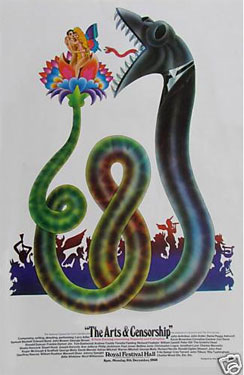
 From a collection of political ephemera. A note attached to an ordinary paper bag which was intended as a sick bag. A protest at a performance at the Royal Festival Hall in 1968 The arts and censorship : a Gala Evening concerning depravity and corruption. Put on by 'The National Council for Civil Liberties and Defence of Literature and the Arts Society', this was a performance involving, among others, Alexander Trocchi and Samuel Beckett. It was  compered by George Melly and with contributions, performance, material or both by  John Mortimer, Roger McGough, The Scaffold, Larry Adler, Fritz Spiegl, Edward Bond, Willie Rushton, Marty Feldman, Barry Took, Billie Whitelaw, Christopher Logue, Adrian Mitchell, Sheila Hancock, Tom Lehrer, Ann Firbank, Paul Jones, William Burroughs, Bertolt Brecht & Dame Peggy Ashcroft.

 Copies of the programme are to be found in distinguished American libraries with the vomit bag and statement laid in. The cover for the night's programme was by Alan Aldridge and his poster for the event is shown below.

The National Front is a far right UK political party. In the 2010 general election they garnered 0.6% of the vote.


VOMIT IS VALID!

This paper bag is presented to you with the compliments of 

****THE NATIONAL FRONT****

We are sure that the most 'avant-garde',  pseudo-communist, drug addicted sex perverts will feel impelled to vomit before the evening's exhibition of "corruption and depravity" is over.

But don't waste your vomit by throwing it at the performers. Instead, store your vomit in the paper bag and give it to Mr John Caldar will Miss Marian Boyars as you leave. These well-known "publishers" will welcome your personal contribution to their forthcoming book : "Gillie de Retz - Saint, Social Reformer and Martyr."

Thank you for your co-operation.

Printed and published by the National Front 11 Palace Chambers, Bridge Street, London SW1. 


There is no trace of the Calder and Boyars book and it appears not to have been published.

Gilles de Montmorency-Laval (also known as Gilles de Retz or Gilles de Rais) (1404–1440), Baron de Rais, was a Breton knight, a leader in the French army and a companion-in-arms of Joan of Arc.

From 1427 to 1435, he served as a commander in the Royal Army, and fought alongside Joan of Arc against the English and their Burgundian allies during the 100 Years' War, for which he was appointed Marshal of France.

In 1434/1435, he retired from military life, depleted his wealth by staging an extravagant theatrical spectacle of his own composition and dabbled in the occult. After 1432 Gilles engaged in a series of child murders, his victims possibly numbering in the hundreds.

He is believed to be the inspiration for the 1697 fairy tale "Bluebeard" by Charles Perrault. His life is the subject of several modern novels, and referenced in a number of rock bands' albums and songs.

Monday, March 25, 2013

From the Library of Guy Burgess


Sold on eBay in late 2008 (price unrecorded but circa £180)

Algernon Cecil. British Foreign Secretaries, 1807 – 1916: Studies in Personality and Policy (London: G Bell & Sons, 1927)

This remarkable survival is the copy of Algernon Cecil’s 1927 book about British foreign secretaries owned by the infamous Cambridge spy Guy Burgess. The front free endpaper bears the inscription: ‘Guy Burgess / Eton 1929’. Burgess was seventeen or eighteen and preparing to take up his place at Trinity College, Cambridge.

Inconspicuous enough at first glance – a plain, dark blue hardcover without dustwrapper, a little worn about the edges – the book harbours a wealth of fascinating annotations in the hand of the young intellectual. There are many sentences in the book which Burgess has placed a pencil line under or alongside, such as the observation that Canning, foreign secretary during the Napoleonic Wars, ‘[as] he had a difficulty in understanding the value of a code amongst nations, so he had a difficulty in understanding the obligations of code amongst men’. Elsewhere, Burgess notes well the observation that the Earl of Clarendon (1850s foreign secretary) ‘betray[ed] himself by a kind of fatalism rather than a fund of resourcefulness [so that in the end] he proved somehow unable to take control of the situation, with the inevitable result that it took hold of him’. It is indeed remarkable that the vast bulk of Burgess’s annotations involve criticisms if not outright damnations of character.


There are also, at the bottom of some pages, Burgess’s own thoughts where he is moved to agree or disagree with the author.

Wednesday, March 20, 2013

Margaret Thatcher "What's Wrong with Politics?"


Conservative Political Centre pamphlet from 1968. A cultured speech quoting from Shakespeare and Sheridan and even the now slightly forgotten French writer Anatole France (who is quoted as saying 'I am not so devoid of all talents as to occupy myself with politics.')

Among the wrongs Margaret Thatcher identifies are too much government; government and its agencies had become too big and the mere man no longer counted. People had lost interest in politics, there was too much reliance on statistics and 'too little judgement…' 

One significant line in her speech is 'Bribery and corruption, which have now gone, used to be rampant.' She mentions the case of a Lord Ashley who spent £12000 on 'refreshments' in order to win Dorset in 1831. Probably more than a million…

Based on a speech given 10/10/68 at the party conference in Blackpool. From the collection of Ian Gilmour (Baron Gilmour of Craigmillar 1926 – 2007) with his marginal linings. The owner of The Spectator in the late 1950s and a distinguished historian. Later he was an anti-Thatcherite Tory Cabinet minister (i.e. what Maggie called a 'wet.') Margaret Thatcher became P.M. 11 years later in 1979.

Thursday, March 14, 2013

Mass Observation Report - Noel Pemberton Billing

From an archive of material of the writer George Hutchinson relating to his time in Mass-Observation (M-O) - a profile of the 1941 Hornsey election far right 'independent' candidate Noel Pemberton Billing, who in an earlier incarnation in his journal, Vigilante, published a homophobic article, "The Cult of the Clitoris" which resulted in a sensational libel trial. Much on Wikipedia about him and the trial and his friend Lord Alfred Douglas.  It is covered in Philip Hoare's  Oscar Wilde's Last Stand: Decadence, Conspiracy, and the Most Outrageous Trial of the Century (1999)

In this report 'inv' = investigator. Note PB's odd clothes--a remarkable collar with points more than six inches long held together by an Air Force brooch. No tie and the monocle lead coming from the tie (see photo.) Also M-O notes his accent (that one would expect to be of the Terry Thomas school) but  which was in fact Cockney. He stood on a policy of aerial reprisals against Nazi Germany but only received a quarter of the vote and the Tory candidate Charles Challen was returned.


HORNSEY BY-ELECTION G. H. 28.5.41

PEMBERTON BILLING

The Independent Candidate.
This report is largely based on daily conversation with and observation of the candidate since last Friday (May 23). It should be read in conjunction with Tudor Jenkins' article in the Evening Standard of May 22, the last page of the candidate’s election address, and CG Gray’s Introduction to his book Defence Against the Night Bomber. (A summary of this book will be submitted later).
Noel Pemberton Billing is 61 years of age–he was born in 1880, in Hampstead. His father was Charles Eardley Billing, of Birmingham–an iron founder. His mother was Annie Amelia Claridge, of Coventry. It appears, therefore, that he is not legally entitled to use the hyphenated surname Pemberton-Billing. That he does so usually–but not always–is, however, quite consistent with his character, as this report will demonstrate.
Oh his birthplace and boyhood he told inv: 'I was born just outside this constituency–in Finchley Road, Hampstead. I went to school at Craven College, Hampstead–and if I give Winston Churchill as much trouble as I gave my headmaster he’s in for a lot. You can get the rest in Who’s Who. '
Who’s Who,  however, provides little information, but the last page of his election address is devoted to a biography sufficient for M-O’s  purposes.
Pemberton Billing is married. According to Who’s Who his first wife, whom he married in 1903, died in 1923. His present wife–to whom Who’s Who does not refer–is probably 45 years of age, a pleasant, plump cheeked, rather stout woman who invariably wears a fur coat.
He has two addresses–25, Chesterfield House, Park Lane, W., and Halliford Court, Walton-on-Thames.
He describes himself as a research engineer.
Appearance, Manner:
Pemberton Billing is well over six feet in height, an erect, impressive figure who very much resembles Conrad Veidt. His short smooth grey hair is brushed straight back and parted in the middle. His cheeks are tanned. He has a distinct–but not disagreeably pronounced–Cockney accent, although, as inv has noted in an earlier report, this is not noticeable except in private conversation. Outdoors and on the political platform he invariably wears a monocle

Tuesday, March 12, 2013

Mass Observation report Kings Norton 1941

From an archive of material of the writer George Hutchinson relating to his time in Mass-Observation (M-O) this includes 38  letters from Tom Harrisson (some slightly argumental.) Originally a reporter for the Yorkshire Post, Hutchinson was a volunteer observer and later became a paid 'wholetime investigator' and was conscripted into the Navy during this time. He later became a journalist and wrote biographies of Edward Heath & Harold Macmillan.


 This is a classic M-O report, honest, opinionated, dispassionate and with an eye for the telling detail. Later we will put up an M-O profile of the 1941 Hornsey election  far right 'independent' candidate Pemberton Billing, who in an earlier incarnation in his journal, Vigilante, published a homophobic article, "The Cult of the Clitoris" which resulted in a sensational libel trial.

KING'S NORTON BY-ELECTION G. H. 6.5.41

SMITH’S ORGANISATION

A small, red-brick house, one of a long row in a working-class part of Selly Oak, is being used as Smith’s committee rooms. The address is 145, Dawlish Road.
The tenant of the house is M, 45, D–Mr. Lacy, who served under Smith in the last war, and, learning of his decision to contest Kings Norton, immediately offered the use of his house as campaign headquarters.
The house has two rooms downstairs, and probably 3 bedrooms. The front room is used as the office, and in the backroom the candidate and his helpers have occasional meals with the Lacy family.
There is little office equipment. The only things that make this poorly furnished room, with its leather–upholstered sofa, cheap sideboards and two easy chairs, look anything like an office are a typewriter (of Danish make, incidentally) and a few box files.
A number of crude notices are fastened to the window. They read: ‘VOTE FOR SMITH’, ‘ VOTE FOR SMITH: BOMB BERLIN’, ‘YOU CAN VOTE WITHOUT POLL CARD’’.
Personnel
Nominally, Mrs. Smith is the candidate’s election agent. But actually Mr Cronow is the election agent.
Cronow is a tobacco manufacturers’ agent in Birmingham, a Manchester-born man. A tall, burly, vulgar, uneducated fellow, who smokes cigars and drives a nice car, and probably has a good bit of money.

Tuesday, February 26, 2013

Anthony Blunt 'The Mind in Chains' 1937

 In the post on the Victor Rothschild we mentioned that he had been at Cambridge with the art expert and spy Anthony Blunt. It is known that he lent Blunt £100 to buy a Poussin  which was sold for £100,000 50 years later as part of his estate. Anthony Blunt a Cambridge don by the early 1930s, was formally recruited to Soviet intelligence in 1937, according to recently released KGB documents, much later than earlier accounts. This explains the seemingly cavalier act of openly writing left-wing (Marxist) art polemic such as his 1937 essay 'Art Under Capitalism and Socialism' published in The Mind in Chains.

 David Mcknight writes in Espionage and the Roots of the Cold War that- 
'Blunt's left wing articles, and his 1935 trip to the USSR, subsequently almost blew his cover. In 1939, as he took tentative steps toward his goal of penetrating British intelligence by joining in the Field Security Police, he was questioned about them. Again, wartime laxness saved the day. In any case Blunt was accepted into MI5 in 1940 where he soon transferred to his preferred section -- counter-espionage -- enabling him to report on measures against Soviet and German intelligence.'  Obviously no-one had closely read his piece in this red-jacketed book. Blunt writes:

Sunday, February 17, 2013

The Individualists (E.V. Knox)

 A satirical piece by E.V. Know ('Evoe' - see earlier entries on him.) Probably never published and it feels unfinished, or at least unrevised. It has a '1984' feeling and also may be mocking Mosleyites who were still around after the war.


A CHARTER OF FREEDOM
 The sound of the rhythmic tramping of many feet aroused me from my day-dreams. I hurried to the window and there, with swinging arms and muscles firm, they strode. The gaze of every marcher was glued firmly to the back of the neck of the marcher in front, and every leg was lifted with the precision of an automaton till the foot was a yard or more from the ground.

  Each, in his left hand, carried a stick or an umbrella, and on that day of slushy pavements and lowering skies the spectacle was one to fill the heart with enthusiasm. Old men were amongst them, veterans of bygone campaigns, grizzled and tanned by wind and sun, pale-faced youngsters of the later levies, gaunt women with steely eyes, and maidens lovely as a rose in June.

  I knew them. They were marching to Trafalgar Square. They were the serried armies of the Individualists. High above them floated the purple banner embroidered with gold and bearing the motto of the Order, "All for one, and one for all." Perfectly disciplined, they divided into companies, wheeled, halted, turned and faced the plinth. The startled pigeons scattered upwards, the lions lay unmoved. The masked leader arose, and the vast multitude, at the word of command, gave him the Salute of Freedom, in which the right arm is lifted to the level of the shoulder, with the palm of the hand held vertical, and then brought suddenly backwards and pressed over the lower portion of the face.