Showing posts with label Architecture. Show all posts

Wednesday, October 14, 2015

1846 Diary of J.W.Penfold—inventor of the octagonal pillar box


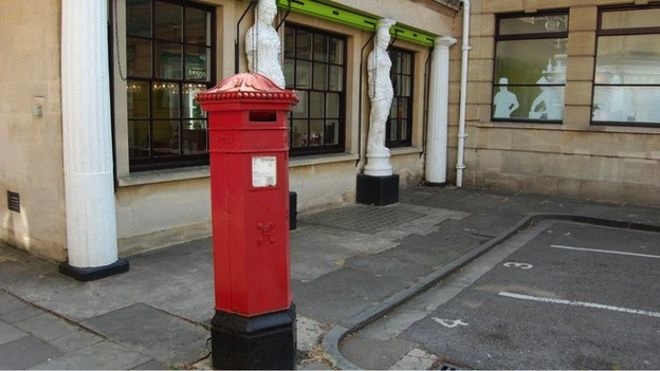
Any Jotters who in their childhood tuned into Danger Mouse, which is about to be revived, must know that his sidekick was called Penfold. It would seem that this character was named after the Victorian architect John Wornham Penfold (1828 - 1909), who is perhaps best known today as the inventor of the octagonal pillar box, several examples of which can still be found in Cheltenham.

But here we have a copy of the Punch Pocket Book for 1846 (discovered many years ago in an antique shop) that once belonged to the future architect and designer, then aged just eighteen, while he was working as a lowly assistant draughtsman in the London office of the renowned architect and illustrator Thomas Talbot Bury (1809 -1877) and his partner Charles Lee (1803 – 1880). At this time Penfold’s duties were various,

Saturday, June 13, 2015

The Red Priest and the Architect

It might perhaps be guessed that Conrad Noel (1869 - 1942), the 'Red Priest' of Thaxted, whose Socialist views once outraged the Tory faithful of his North Essex parish, would be sympathetic to the Art and Craft movement, whose guru was the Socialist poet and designer William Morris. But an inscription, dated April 1906, in a copy of The Country Cottage, presented to him from its co-author, George Llewellyn Morris, confirms it.

Amazingly, I found this inscribed copy of the little book, a hymn to the virtues of both the humble thatched labourer’s cottage and its much more sophisticated Arts and Crafts imitations in brick, plaster and tile, profusely depicted in photographs, in 2006 among the trashy novels in the ten pence box outside a well known bookshop in Saffron Walden. The book had been given to Noel four years before he became Vicar of Thaxted, and it had somehow found its way from here to that bookshop, just 12 miles away, in the intervening years.

The only facts that can be discovered about George Llewellyn Morris

Wednesday, May 6, 2015

The Tragedy of Copped Hall


The effects of the First World War were wide and long lasting, not just for those who were directly involved in it, one way or another , but for the architectural heritage of Britain. The deaths of so many sons of the upper class meant that estates that had been run so successfully up to 1914 were plunged into uncertainty. Great mansions were sold off or demolished. A different fate befell one great house and its astonishing gardens in Essex, as some clippings found among the papers of the late Peter Haining, who must have passed the site regularly on his route to and from his Essex home, tell.

Today, for those driving clockwise along the M25 the roofless ruins of Copped Hall, situated on the edge of woodland just south-east of Epping, are an intriguing sight. For most of the War the mansion, which had replaced a more interesting Elizabethan house and gardens in 1753, was a cherished family home. The elaborate gardens, a late Victorian theatrical tour de force by C.E Kempe, better known for his stained glass designs, were remarkable enough to feature in a lengthy article in Country Life in 1910. But seven years later, on one night in November 1917 all was to change.

Friday, November 21, 2014

Boozing with the Victorian Society in Crouch End, Hornsey and Harringay


Found in a box of books is this photocopy of a typewritten guide to a ‘pub crawl’ (walk no 41) of various late Victorian ‘gin palaces’ in North London arranged by the Victorian Society on 16th September 1966. The guides were two architects-- Roderick Gradidge and Ben Davis—both of whom had designed interiors for Ind Coope. Judging by their descriptions of the pubs they planned to visit, both were also passionate and knowledgeable fans of late Victorian architecture and design. The grand plasterwork of the ceiling cornices and Art Nouveau stained glass is pointed out as being of special interest. But the two men also emphasised the ways in which Victorian pub architects tried to make   their interiors both glamorous and homely as a way of getting their (mainly) lower middle class drinkers (mention is made of Mr Pooter’s ‘raffish’ friends) to spend hours away from their more humble abodes, much (we might add) in the way that the designers of Music Halls and northern shopping arcades  (one thinks of Frank Matcham ), and grand hotels, were doing in the same era. Here are the guides admiring the combination of grandeur and intimacy found in the Queen’s Hotel, Crouch End (below):
All the way round there were through views, glimpses of the other bars, and as a result one was able to feel that one was standing in one part of a single large space, large enough to tolerate the considerable height without
become vertical. Since the space was so well subdivided…one could feel secluded in a sufficiently small and enclosed space, but since the proportion of the greater space was horizontal a feeling of repose was retained which could not have belonged to tall, restricted vertical rooms.
© Copyright Julian Osley
This method of subdividing an area into small bars by means of partitions, which were half-glazed  with semi-obscured glass, and were not much above six feet high, was peculiar to Victorian pubs, and goes a long way to explaining the incomparable drinking atmosphere they provide... 


Along with the praise of such period interiors and the predictable imprecations cast on alterations by designers from the 1930s onwards, there are several features of the guide that point to its mid-sixties origin. Firstly, the crawl began at ‘6.30’ and ended at closing time.
So no sign of the 24 hour clock here-- presumably so as not to confuse the older topers in the Society, some of whom may have been born when these pubs were being built.-- though I seem to recall that the 24 hour clock had arrived on bus time- tables in the London area as early as 1962.

Monday, April 7, 2014

London Night and Day 1951


London Night and Day, illustrated by Osbert Lancaster, edited by Sam Lambert (Architectural Press, 1951)

Surely one of the most entertaining of the plethora of books brought out in the wake of the Festival of Britain. The coloured cover illustrations and the vignettes in black and white were by Osbert Lancaster, a friend of John Piper—the same John Piper who is named in a section devoted to the Festival, to which he contributed, among other things, a superb semi-abstract panorama. If you hadn’t been informed that Lancaster had designed the cover, you would have attributed it to Piper, whose style of portraying shop fronts is showcased in Buildings and Prospects, which had appeared just a few years earlier. Lancaster’s style is identical. Was Piper concerned that he was being flagrantly copied by Lancaster? Probably, but according to his biographer Frances Spalding, the two men were friends.

London Night and Day, like Stanley Johnson’s Soho (c1949), previously reviewed on Jot101, is a sparkling read. It seems to be multi-authorial, though in the list of names that feature in the Acknowledgments only that of J. M. Richards would be recognised by most people today. However, a few of the others, such as Colin Boyne, and Gordon Cullen were prominent in the world of architecture back then. One or two of the remainder may have been restaurant critics—seeing as at least a third of the book is devoted to pubs, restaurants, cafes and night clubs. Although his name doesn’t appear anywhere in the book, the voice of John Betjeman, then at the height of his fame, seems to colour much of the text. Perhaps he is there under a pseudonym, perhaps as the ‘editor’, Sam Lambert. After all, this is the sort of guide to which he would have been attracted. Betjeman  also worked with Richards at the Architectural Review and was a close friend of Lancaster’s. Neverthess, the best Betjeman bibliography, published by the Betjeman Society, has nothing to say about London Night and Day.


The guide is arranged to reflect a whole 24 hours in London, hour by hour. Under '4 pm cuppa' some attractive tea shops and cafes, none of which have survived, are described. Back in 1951 Yarner’s Coffee House, at 1, Langham Place , was the place to find BBC types. I  know for a fact that the abstemious Geoffrey Grigson, at various time both a producer and a contributor, was a frequent customer. His more thirsty colleagues, like Dylan Thomas, Louis MacNeice and Rayner Heppenstall, were generally to be found in a favourite local around the corner, propping up the bar way beyond the time allotted for lunch.

Two hours later, if you fancied a beer or a glass of wine after your day in the City, the Jamaica Wine Bar, off Lombard Street, would be a good place to overhear city types gossip, although in those innocent days before financial meltdowns, that accountant who looked like Bob Cratchit, was probably only on  about £12 a week.

Wednesday, August 7, 2013

The Politesse of Valdré

An interesting an uplifting anecdote of true impulsiveness found in John Julius Norwich's 1990 Christmas Cracker. Viscount Norwich was a jotter before jotting was invented - an Ur jotter. Respect. His Cracker booklets are sent to a few thousand of his closest friends and consist of information and wisdom culled from his library and also presumably sent to him by loyal correspondents.

Vincenzo Valdrati or Valdré (1742-1814) was an Italian painter-architect who came to England in the 1770s and designed, inter alia, several of the state rooms at Stowe before settling in Ireland where he became Architect to the Board of Works. From Howard Colvin's superb Biographical Dictionary of British Architects I learn that "while at Stowe he attended a wedding and when the bridegroom failed to appear, he was so moved at the bride’s distress that he chivalrously offered himself as a substitute – and was accepted."

Tuesday, January 29, 2013

Books from the Library of Eileen Gray

Sold on the internet about 2001 - some of the cult designer's books.

Photo (below) of Le Corbusier and his wife taken by Gray at her house E-1027. Designed by Gray and built at Roquebrune Cap Martin in 1929. Oddly Le Cobusier died of of a heart attack while swimming off the rocks beneath E-1027 in 1965.

 Small archive of books from her library and books about her. 21 books in all--9 books from her library dated from 1885 to 1961 and 12 books and pamphlets about her mainly 1970s and 1980s, mainly in English. These books were inherited from the designer Eileen Gray by her niece and executor the English painter Prunella Clough.  Books from Eileen Gray’s library include 1.‘Alice Through the Looking Glass’ (56th thousand) presented to her and her sister Thora from her brother Jim. 2. Whistler's  - The Gentle Art of Making Enemies  (boldly signed by her on the half title)  1904 reprint 3rd ed. 3. Her copy of Walter Pater 1901 edition of ‘Greek Studies signed by her in pencil in 1903. 4.  William James ‘Text Book of Psychology’ 1892 with bold ownership signature. 5. A small leather bound New Testament (about 1890) presented to her by her mother in 1907. 6.  A ‘Works of Browning’ handsomely bound by Sotherans presented to her by her brother Jim on her birthday in 1905. 7. Her own copy of the French wraps edition of Antonin Artaud’s ‘Van Gogh. Le Suicide de la Societé.’1947. First ed. 8. G.Constant Lounsbery. Buddhist Meditiation in the Southern School.1950 Signed presentation copy from GCL to Eileen Gray  ‘in  admiration of her pursuit of beauty.’  9. ‘The Universal Self . A Study of Paul Valery’  by Agnes Ethel Mackay (1961) with a signed presentation to Eileen Gray  from the author ‘with affectionate homage.’ There are also 12 modern books and pamphlets on Eileen Gray collected by Prunella Clough including auction catalogues, a copy of a thesis ‘Eileen Gray, Un Autre Chemin pour la Modernité...Un Idee Choreographique’ in which the author mentions her indebtedness to Prunella Clough. Also the magazine Archithese, August 91 special Eileen Gray issue and an 1994 academic offprint ‘E.1027: The Nonheroic Modernism of Eileen Gray’ which is a signed presentation copy to Ms Clough.