Showing posts with label War. Show all posts

Thursday, May 15, 2014

A flier for The War of the Worlds (1897/1898)

"...across the gulf of space, minds that are to our minds as ours are to those of the beasts that perish, intellects vast and cool and unsympathetic, regarded this earth with envious eyes, and slowly and surely drew their plans against us."


Found - a review slip or pre-publication publicity (a flier) in a first edition of H.G. Wells The War of the Worlds (Heinemann, London 1898) one of the greatest Science Fiction novels of all time.  The novel had previously appeared in serialized form in 1897, published simultaneously in Pearson's Magazine in the UK and Cosmopolitan magazine in the US. The reviews are from magazines and newspapers of the time including one from a French paper Mercure de France which says that Wells surpasses Jules Verne.
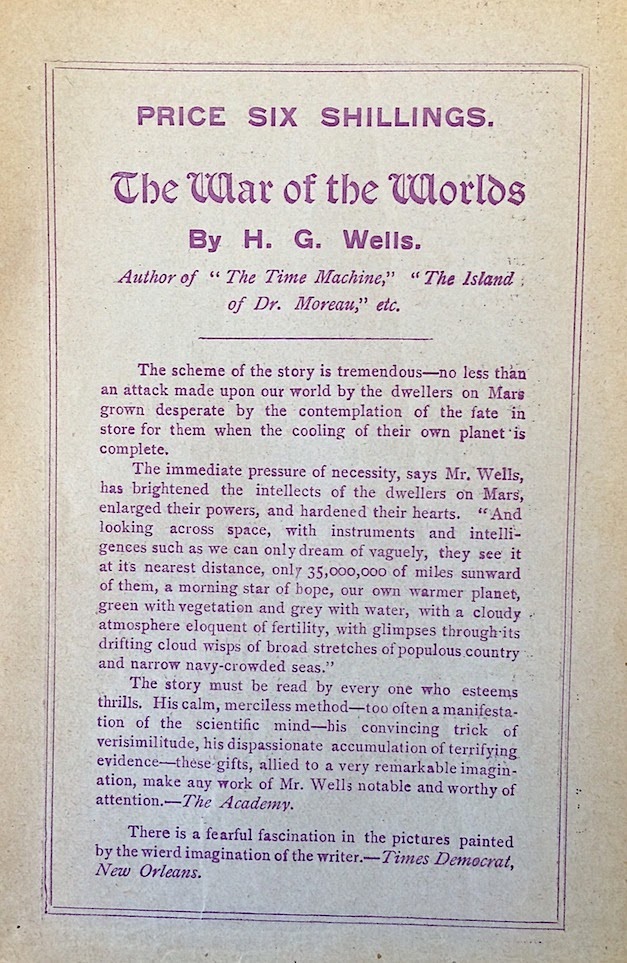
The scheme of the story is tremendous – no less than attack made upon our world by the dwellers on Mars grown desperate by the contemplation of the fate in store for them when the cooling of their own planet is complete.

The immediate pressure of necessity, says Mr Wells, has brightened the intellects of the dwellers on Mars, in large their powers, and hard and their hearts. "And looking across space, with instruments and intelligences such as we can only dream of vaguely, they see it at its nearest distance, only 35,000,000 miles sunward of them, a morning star of hope, our own warmer planet, green vegetation and grey with water, with the cloudy atmosphere elegant of fertility, with glimpses through its drifting cloud wisps of broad stretches of populous country and narrow navy-crowded seas."

The story must be read by everyone who esteems thrills. His calm, merciless method – too often a manifestation of the scientific mind – his convincing trick of verisimilitude, his dispassionate accumulation of terrifying evidence – these gifts, allied to a very remarkable imagination, make any work of Mr Wells notable and worthy of attention.(The Academy.)

Astonishing power of illusion. – Daily Chronicle

Mr H.G. Wells, the novelist has made such notable use of the scientific imagination as applied to fiction, is at the present moment enchanting the readers of Pearson's Magazine with an account of an invasion of the Earth by the inhabitants of Mars. – Spectator.

 'Curieux…et original: supérieur aux fantasies de Jules Verne: aver les qualités brilliants et les préoccupations sérieuses de R.L. Stevenson, avec dans le bizarre et terrible quelquefois des aspects d'Edgar Poe." (Mercure de France.)

Wednesday, September 11, 2013

A Devastated Bookshop


Sold in auction in New York 25/6/13 as part of  'The Library of Stuart and Caroline Schimmel' a pair of book related watercolours. These paintings appear to have been traded several times in the last 20 years but here made $3250 including the 'juice' (i.e. Bonham's sturdy 25%). Described thus:-


CANYNGE HOUSE—BRISTOL

PARKMAN, ALFRED EDWARD. 1852-c.1930. Two original watercolors, "Canynge House, Redcliffe Street after the Great Fire 1881," 295 x 242 mm and 303 x 247 mm, the first titled and signed "Parkman." Float-mounted, matted and individually framed.

Canynges House was built in the middle of the 15th century by a family of rich Bristol merchants; the original Renaissance fireplace is depicted in the first drawing. By the 19th century the house was occupied by C.T. Jefferies & Sons, printers and booksellers, and is shown here after the disastrous fire of October, 1881.

These slightly  disturbing images are reminiscent of the well known photos taken of the library at Holland House in Kensington, London after enemy attack in WW2.

Wednesday, May 22, 2013

Rant against War (Charles Richet)

An impressivee  rant against war by the Nobel Prize winning French scientist Charles Richet published about 1925 in his book Idiot Man or The Follies of Mankind (L’Homme Stupide.) A now rare and undeservedly forgotten book in which Richet seems to see ahead to all the millions of deaths in wars of the next 90 years...

When I evoke the vision of war–bloody, cruel, hideous war– burning, shuddering pictures instantly swarm into my mind, so numerous and vivid that I am dazed by them.
Thanks to war, the proofs of human ineptitude are so blatant that any words could only weaken them. But I shall do my best to dam this overwhelming flood of ideas and to calm my indignation.
It is futile to reiterate that war means death, death, and yet again death. But it is not these countless deaths that are my chief charge against it. After all, we must all die someday. A little sooner, a little later, what does it matter?
There are fifteen hundred million human beings on the face of the globe, and glorious war of 1914–18 was only able to destroy fifteen millions. That's nothing, for these fifteen millions represent a mere fraction of mankind; one per cent, which is next to nothing. Two years of increased fertility will make up for this holocaust. And I am almost tempted to use the words of Napoleon, who murmured with a kindly smile as he gazed on all the corpses which his vain glory had piled up on the field of Eylau: "One night in Paris will make up for all of this."

And now, among all the peoples of Europe, there reign hatred, abuse, outrage and calumny; with cries of anger, vengeance, and fury which blacken the soul. War stirs up all the base, fierce instincts peculiar to man; man who is baser and fiercer than the jackal or the hog. Everything low, vile and bestial is given full rein. A vain mountebank like Wilhelm II, a brainless old brute like Hindenberg, are worshipped as gods by a hundred thousand imbeciles. All justice scorned; all falsehood exulted; all pity insulted. The whole of humanity wallowing happily in blood and slime, and finding therein some obscure, perverse joy more hideous than a noble grief. 
Apparently man, in his quest for that which will at once injure and degrade him to the utmost, has finally succeeded in attaining the maximum. He has bent all his energy, all his cleverness, all his passion to this painful task. And with great success. The result has been splendid. During five or six thousand years man had tried his strength in continuous, but comparatively bloodless little wars,. But these were sketchy, childish efforts, mere preludes to the magnificent work accomplished in 1914–18...

Carry on, comrades! Keep it up–keep the ball rolling! Here you are at the dawn of the new era. For this war is only a truce. Wars will break out anew and our grandchildren will see still more glorious massacres; they will undergo more acute and prolonged suffering.


Forward! Bon appetit! Perfect the art of killing. There are still splendid things you may invent; you have still greater heights to scale. Strain every nerve! Toil on! A few years hence you will achieve superb results.
Shed the last vestiges of timidity! However great your savagery, your imbecility will far surpass it; and compared with it your savagery will be as a reed beside the Eiffel Tower.

Pitiful humanity has fallen so low that men kill without hating each other (the phrase is from Bossuet) and they no longer fill me with pity, but the black shame. Yes, in my inmost being, I am humiliated because I belong to this vile animal species, the most foolish of all created things.

Friday, March 8, 2013

Velly Silly, Mister Hitler

An interesting example of ephemera from World War II, put out by the National Refugee Service (a 'constituent agency of the United Jewish Appeal for Refugees and Palestine') - it puts forward the example of a Jewish refugee, Private John Goetz, who has found 'home and freedom' in America after being 'tossed out' of Germany. He is now bravely fighting the Japanese - hence from their point of view Hitler has made a 'velly silly' move. 

 He won the Purple Heart and says that when he gets home from war he will have so many medals he will look like 'one of those doormen in front of a Russian night club...' His opinion of Japanese soldiers is very low. 


Thursday, January 17, 2013

BOOKS, THEATRES & BOMBS.

From the papers of Ifan Kyrle Fletcher, sometime book dealer, Edward Gordon Craig specialist, theatrical history and dance expert. Published in a somewhat revised form in 'London Calling' (BBC Overseas service journal) June 5 1941. 6 million books lost in blitz at Paternoster Square - unimaginable treasures.

BOOKS, THEATRES & BOMBS.
by Ifan Kyrle Fletcher
February 7, 1941.

Nearly eight years ago, as we can now see, the Nazis revealed themselves in their true colours. What happened on the night of May 13 1933 was no obscure diplomatic or political more, unknown to all but statesmen. It was a simple act of destruction which has profoundly effected the lives of us all. Do you remember? Twenty-five thousand books were made into a bonfire outside the University of Berlin and were destroyed in the presence of about forty thousand people.
    At the time it may have seemed nothing more than the triumph of one political party over another but we know now that all the violence and suffering of the interviewing years are, as it were, lit up by the flames of that bonfire. By its light we see and understand another fire seven and a half years later - the fire of the night of December 29, 1940, when, in the district around St Paul's Cathedral, nearly six million books were destroyed and some of the most precious treasures of our architecture were wrecked. By its light we see and understand other events, the destruction of the library of University College, London; the destruction of the library at Holland House and the partial destruction of this lovely and historic mansion, for which the people of West London had feelings of the warmest affection. We see and understand the destruction of the library of the city of Tours and the looting of the museums and art collections of Austria, Czechoslovakia, Poland, Holland, and Belgium. Recently, the Louvre and the famous chateaux of France have been plundered, not to satisfy artistic craving for possession but to provide funds from the art markets of neutral countries for more weapons of destruction.