Showing posts with label Ghosts. Show all posts

Friday, January 9, 2015

A.L.Rowse and Lady Cynthia Asquith —a ghostly company

This two page letter from professional Cornishman, popular historian and alleged poet, Alfred Leslie Rowse, to ghost story compiler Lady Cynthia Asquith, came to light when I was sorting out a bunch of old letters recently. Dated March 29th and written with a ball point pen on All Souls College notepaper, its date would be 1951 or not long after. This is because in the letter Rowse thanks Lady Cynthia for remembering that he enjoyed ghost stories, by sending him a copy of her 1951 anthology, What Dreams May Come (though the book is not mentioned by name).This collection contained a number of her own stories, some of which Rowse singles out for special praise, as being not particularly ‘ghoulish‘, but instead ‘far too delicate and subtle and so beautifully written‘.

…I greatly appreciated the ‘ Olivia’ -like theme and atmosphere of ‘ The Lovely Voice’, the ‘Jane Eyre’-like ending of ‘The Playfellow’ , the conjured-up  Dickensian atmosphere of ‘ The Corner Shop ‘. But the masterpiece, I thought, was the last. ‘God grante that she lye stille’ —a perfect story bewitchingly evoked. ( I think my choice betrays too my especial response to the historical & nostalgic ).

Saturday, September 6, 2014

The Ghost Man - a blurb from the 1930s

Found in the massive and unending Donald Rudd collection of detective fiction -a Gerald Verner thriller The Ghost Man (Wright and Brown, London 1936) in its sensational jacket.
Gerald Verner was the pseudonym of John Robert Stuart Pringle. He had over 130 books published under four names during his lifetime and was hugely popular with his audience and a favourite of the Duke of Windsor, who was presented with an especially bound set of 15 of Verner's thrillers. He attempted to take over the mantle of the prolific (and wealthy) Edgar Wallace after his death in 1932. The jacket has elements of Wallace, even down to the style of the logo. The blurb on the inside flap reads:


Who was the man called Conner, bank robber and murderer, who was hanged at Wandsworth Prison? What connections did he have with the murderer of the Shabby Peddler in the garden of Janet Lacey's country cottage? Why did he search the place so thoroughly before he was killed? And what was the significance of the stanza from the Rubaiyat of Omar Khayyam? Mr Gerald Verner's new mystery is  so full of excitement, his plots so ingenious, mysterious, and so subtly unfolded that it will be impossible
to put the book down until the last word has been read.

The book is not listed by Bleiler (Supernatural Fiction) or George Locke (Spectrum of Fantasy)which would indicate the ghost is rationally explained. It is, however, an Omar Khayyam item..

Thursday, July 3, 2014

The Ghosts of Glamis


Found -  The Ghosts of Glamis - a typescript, apparently unpublished, from around the 1960s. Glamis is the seat of the Queen Mother's family, the Bowes-Lyons, and is said to be the most haunted castle in Britain. There is the Grey Lady who haunts the chapel, a tongueless woman haunting the grounds, a young black servant boy haunts the seat by the door to the Queen's bedroom, also the ghost of the gambler and hell raiser Earl Beardie has free range of the house (he lost his soul to the devil in a card game). There are more. The castle is also mentioned in Shakespeare's MacBeth, and the murder of King Malcolm the II is supposed to have taken place in one of the rooms.This seems unlikely as the castle dates from the 14th century and the murder from the 11th century. The typescript is of unknown provenance but seems to have been written for publication...

The Ghosts of Glamis

     Glamis Castle is certainly the most noteworthy castle in Scotland, and it held in special pride and affection by the Scottish people. The long records which tell of its history as a Royal residence, the romance of the long ownership by the Lyon family, the many legends and ghostly happenings which are connected with it are fittingly expressed in the building itself. Glamis - that most haunted and stately old pile - is the very embodiment of the castle of romance.
     Still proving the validity of its ancient boast that it is the cradle of kings, it has, in our day, added to its memorable past by having been the childhood home of the Queen Mother, whose father, the late Earl, was the 14th of the line of Strathmore and Kinghorne.
     Legend, as well as history, has enriched the story of Glamis.

Wednesday, April 30, 2014

Stephen Crane and a Sussex Ghost


What is it about young ex-pats writing single performance plays performed by amateurs at Christmas? A recent Jot told the story of The Princess and the Pauper, a drama by the 24 year old British humorist Harry Graham, which was performed by amateurs at Christmas 1900 in Government House, Ottawa. Exactly a year earlier, a one-off performance of The Ghost, written mainly by the 27 year old American Stephen Crane, best known for The Red Badge of Courage, was acted out by amateurs, at Brede, near Rye in Sussex.

In 1899 Crane and his wife Cora were renting Brede Place, a crumbling mainly late medieval manor house, a mile from the village, with huge fireplaces but no indoor plumbing.


Though the Cranes were enchanted by its old-world charm and maintained an open house for all and sundry, some visitors were less enamoured. One was Karl Edwin Harriman, who in print complained of the ‘chill, damp and draughts of the old house ‘, and of the wind ‘which whistled through the casements every moment of the day and night ‘. Ford Madox Ford described it in Mightier than the Sword as ‘ an ill-fated mansion…full of evil influences ‘.

Friday, February 14, 2014

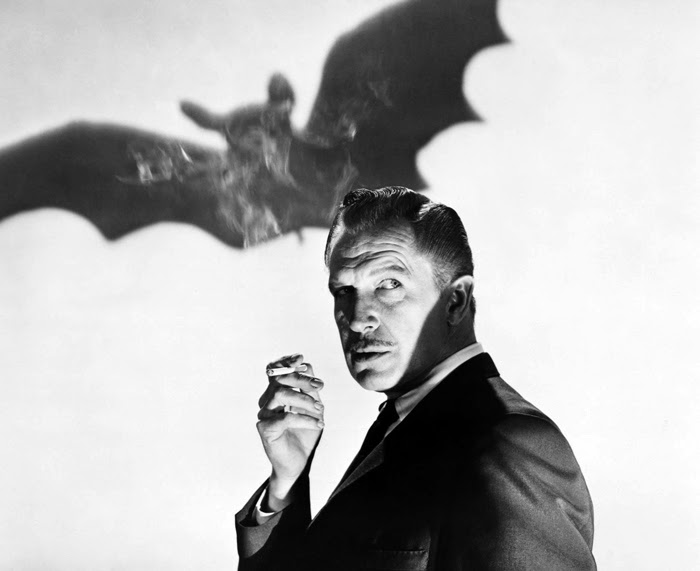
Vincent Price sees a ghost..

Found in an anthology of  supernatural encounters by the famous - I Saw a Ghost edited by Ben Noakes (Weidenfeld, 1986)- this account by Vincent Price.

On 15 November 1958 I had an extraordinary glimpse of the unknown  whilst on a flight between Hollywood to New York   I was immersed in a book**  for most of the journey, but at one point, glanced idly out of the window.  To my horror I saw huge, brilliant letters emblazoned across a cloud bank spelling out the message "TYRONE POWER  DEAD".  it was a terrific shock, I began to doubt my senses when I realised that nobody else on the plane appeared to have seen them, but for a few seconds they were definitely there, like huge teletype, lit up with blinding light from within the clouds.  When I landed in New York I was told that Tyrone Power, had died (suddenly) a couple of hours earlier.

**In one account the book is a classic French novel - which might explain something. Also worth noting is that Power was a close friend of Price. The book bears a presentation to the artist Ronald Searle from Noakes. RS contributes a similar piece about being woken up in the South of France  by Laura West Perelman the late wife of his friend Sid Perelman (and sister of Nathaniel West) who announces to him 'Sid is Dead' - the next morning he receives a call telling him that Perelman had been found dead in his hotel room in New York during that same night.

Tuesday, February 4, 2014

Ghosts as a symptom of dyspepsia

Frankfort-Moore in his Italian Home
From A Mixed Grill : a Medley in Retrospect / by the author of "A Garden of Peace". London : Hutchinson, [1930.] The anonymous author was, in fact,  Frank Frankfort Moore (1855–1931) an Irish dramatist, biographer, novelist and poet. Born in Limerick, Ireland, Moore worked as a journalist (1876–92) before gaining fame as an author of fiction. The frontispiece of this book shows him in his 'Italian Home' - this was actually a house in St. Leonards called 'The Campanile' filled with Italian artefacts that was on sale  in 2010. On the subject of ghosts he is somewhat sceptical but most subjects, as the title implies, are seen from a slightly  gastronomic viewpoint:


All the great ghost-seers on record have been also eminent dyspeptics - men and women who were deficient in pep or who had ruined their digestions by irregularity in diet or by a wrong diet. The ghost is really a symptom and it is rightly so regarded by the medical profession. We all know the sort of person who is  associated with a ghost story - the ethereal girl like the sister of Sir Galahad who saw the Holy Grail - "I thought she might have risen and floated" - that girl has really risen and floated in innumerable ghost stories - the type of girl on whom that form of rash, known as the stigmata, has from time to time appeared. This may be the ghost of indulgence. In the days of gluttons there was a glut of ghosts, and there are few men of middle age to-day who have not had some experience of the man whose ghosts take the questionable shape of blue monkeys pr black cats, sometimes even of such minor crawling things as spiders or black beetles in natural colours, or, more frequently, snakes of no recognised classification. These are all the result of an over indulgence in the drug known as alcohol. Other drugs such as opium or cloral are productive of more pleasing spectral shapes; but this class of ghost has nothing in common with the phenomena of Spiritualism. Their capacity of self-expression does not go beyond the ordinary gibber. They are not worthy of serious consideration, except, of course, from the standpoint of a medical prognosis.

A humble variant is, of course, the nightmare, a horror due to such a ridiculous accident as a slipped pillow or a superfluous eiderdown, but more frequently to an incautious or a too hasty supper...

Thursday, August 15, 2013

Kenny Everett on the Ouija Board

From a paperback called I've Seen a Ghost - True Stories from Show Business by Richard Davis (Granada, London 1979). A series of mostly tall, real ghost stories from British stars of the time -Jon Pertwee, Roy Hudd, Pat Phoenix, Vincent Price, Bob Monkhouse, Rula Lenska etc.. There are the usual actor's superstitions and tales of ghosts seen in old theatres...the one from Kenny Everett could be filed under 'more things in heaven and earth' or Kenny was simply blagging - which seems unlikely as there is no joke or punchline. Also it is worth noting that this was before the time of proper mobile phones...

It happened when we were staying at Pete Asher's house in Surrey, near Rosper. It looks rather like a Chinese house – all made of paper walls and bits of stick. And it was by a lake, an 8 acre lake with two islands on it. All very deserted, it was.

We had a cameraman and his assistant staying with us, and we decided to have a go with the Ouija board.  Well, the cameraman got a message through from his girlfriend; he said "that's odd - she's not dead". And she said by means of the Ouija board that she'd died that day. She'd taken a load of pills and she was in Bicester Mortuary. He couldn't believe this. He thought we were messing around, though I don't think any of us would have been quite as cruel as that. So he rang her dad, and her dad picked up the phone and he was in tears, because she had just taken a load of pills and he had taken her to the mortuary. The cameraman had been with us for two days; the phone hadn't rung and there was no way he could have known.