Showing posts with label Rock Music. Show all posts

Thursday, November 12, 2015

The Beatles - Where do they go from here? (1965)


Found in Photoplay from April 1965 this speculative article about The Beatles by Anne Hooper -'Where do they go from here?' Some now slightly forgotten names are mentioned -Pete Murray, Ray Noble, David Jacobs, Maureen Cleave and also the unfortunately not forgotten Jimmy Savile ('that crazy, way-out disc jockey') who claims (surely falsely?) that  he worked at Liverpool  docks with the lads...

What is to happen to our golden boys? How along will they last? What will they be doing in , say five years time? These are among the dozens of questions that are asked today about the phenomenal Beatles.

Rumours of splits and break-ups are often heard. Fierce competition from groups like 'The Rolling Stones' has had the fans shaking their heads and saying, "Well, they've had it good, but can't last." But it has, though. The Beatle's last single "I Feel Fine" proved that the boys were still very much on top. They haven't been eclipsed by the Stones and, with their second film about to be produced, they're not likely to be by anyone...

Monday, November 9, 2015

Accolades for Elvis, King of Rock

Found in an amusing slim music trivia paperback Rock's Follies: Soundbites from the world of rock this collection of (mostly) eulogistic quotes about Elvis Presley, oddly titled 'The father of us all?' The book was given away with the April 1996 issue of  men's lifestyle magazine Maxim. Amongst the quotes were these (1-11) and we were inspired to find a few more (12-22)  by this excellent book (illustrated  by the late, great Ray Lowry, R.I.P.) The last entry by Nik Cohn would probably end up in Pseud's Corner in the cynical U.K. but it addresses the King's spiritual side.

The father of us all?

1. Without Elvis, none of us could have made it. - Buddy Holly

2. I didn't think he was as good as the Everly Brothers the first time I ever laid eyes on him. - Chuck Berry.

3. It took people like Elvis to open the door for this kind of music, and I thank God for Elvis Presley. - Little Richard.

4. Gosh, he's so great. You have no idea how great he is, really you don't. You have no comprehension - it's absolutely impossible. I can't tell you why he's so great, but he is. He's sensational. He can so anything with his voice. He can sing anything you want him to, anyway you tell him. The unquestionable King of rock 'n' roll. - Phil Spector.

5.When I first heard Elvis' voice I just knew that I wasn't going to work for anybody; and nobody was going to be my boss. Hearing him for the first time was like busting out of jail. - Bob Dylan.

Saturday, October 10, 2015

The Cavern - a view from 1964

Found in Arrows 87 (Summer 1964, edited by Roger Ebbatson) this amusing piece about 'Beat Music.' The magazine was produced by Sheffield University Union and had poems articles, graphics etc., This article was by Peter Roche a poet who was affiliated with the Liverpool Scene. He edited a 1960s anthology Love, Love, Love (The New Love Poetry) and is to be found in various poetry collections and anthologies. He was also a friend of John Peel and Cream lyricist Pete Brown.The article shows how, at the time, The Cavern (the club where the Beatles played and were discovered) was not universally loved...

Beat City by Peter Roche

Let me tell you all  a fairy story. Once upon a time, in a  city far away across the hills to the west, there was an old warehouse, in an alley off a side street. And underneath this warehouse was a cellar, where the local groups used to play their music far into the night. And people who lived on the banks of the river used to go to this cellar, because it was somewhere to go when the pubs had kicked out and you were half cut and there was nowhere else to go, and anyway there was a fair old chance of picking up a judy there. And everyone was fairly happy, minding their own business and having the occasional punch-up.

Thursday, May 7, 2015

P.J.Proby

Who remembers P.J.Proby? He was that twenty something, good looking Texan, born James Marcus Smith, who with his jet black hair tied back an  energetic, gyrating act and hit single covers from West Side Story ( 'somewhere there’s  a place for us…) was the sensational new male vocal act in 1965---a sort of Elvis lookalike, but with a better voice, many thought, than the King of Rock himself. Then he split his pants, not once but twice, and was banned from the BBC and from just about every venue in the UK. By then he had a fleet of Rolls Royces a yacht and Lear Jet and homes in Beverley Hills and Chelsea, but nowhere to sing, at least in the UK, which had become his adopted home.

Frustrated, he still recorded the odd album, and once the split pants furore had died down, he took to the stage in various musicals.   Before too long, however, he had an alcohol problem and a failed marriage. The cars and properties were liquidated, but he continued to sing and act, most notably playing Elvis. But the drinking continued. Other marriages went under. His lowest point came in 1985, according to a cutting from a magazine  collected by Peter Haining, when he was snapped in his Bolton bedsit slumped on a sofa clutching a can of Special Brew—still just 47,but hardly recognisable as the sleek mid sixties sex symbol. By then he was reduced to gigs in northern clubs, but with a reputation as a ‘no show’. Haining seems to have been fascinated by the singer’s fall from grace,

Monday, March 9, 2015

Mr. Presley Sheds Some Mannerisms

Found in an old book, a press-cutting from November 10th 1960 about Elvis. The style and look is of The Times but it is not stated.They regard the movie G.I.Blues as 'nothing' but seem (in a very stiff manner) to have fallen under Elvis's spell..
On the back is stuck another cutting, tabloid in style, stating that Sandra Dee does not like Elvis ('he acts a little undignified when he wiggles…') and  noting Hollywood's Louella Parsons remarks about the King - 'I'm  glad I put my money on Elvis Presley in those early days when so many people were ridiculing him -in GI Blues he sings well without wiggling and acts in a perfectly natural way...'

Mr. Presley Sheds Some Mannerisms

Style of his own in 'G. I. Blues'.

The young popular entertainer, especially if he is singer, is apt to be judged less by reason than by prejudice - and prejudice derives its impulse largely from the accident of age. A large and enthusiastic tick will be placed opposite his name by the vast majority of those who have yet to experience the joy of being 21; crabbed middle-age, and all on the wrong side of it, will draw through it a thick line, eloquent of disgust and disapproval.

Mr. Elvis Presley had had considerable experience of both kinds of treatment, but even those most determined to condemn must, it they are at all fair-minded, have second thoughts after seeing 'G. I. Blues', directed by Mr. Norman Taurog and now to be seen at the Plaza Cinema. The film itself, one of those American service comedies which so painfully stress the licentiousness of the soldiery, is nothing, and serious criticism would soon lose itself in the vast wastes of vulgarity that are its natural home, but Mr. Presley himself is a different matter.

As Tulsa, a tank gunner serving in western Germany, he is an acceptable person. Gone are the "side-boards" that were such an offence to the conservative, and gone, too, are those convulsive jerks of the body, making him resemble a jelly in a high wind, which used to accompany his singing. He has in this film a considerable number of songs, some of them above the average in tunefulness, to sing, and he sings them pleasantly. He has an unmistakable style of his own, yet there are moment when the ghostly image of the youthful Bing Crosby flickers across the screen.

Sunday, February 15, 2015

Silence Please!

Bits and Pieces: The Penguin Book of Rock and Pop Facts and Trivia (Steve Smith 1988) has a useful section on silence in music. Naturally it starts with John Cage's piece entitled 4′33". I have seen the sheet music for this which, as I recall, has instructions about opening a piano and closing it at the end, after 4 minutes 33 seconds of obligatory silence. Smith notes that the performer, 'usually a pianist,' is expected to use his fingers to show the audience which of the song's three parts they are listening to… In Wikipedia's piece they mention that Frank Zappa recorded it as part of A Chance Operation: The John Cage Tribute on the Koch label in  1993. It was also recorded by Swedish electronic rockers Covenant in 2000 (the piece was entitled You Can Make Your Own Music.)

4'33" was first publicly performed in 1952. In 1953 CBS issued a blank record entitled 3 Minutes of Silence - it was intended for juke boxes, enabling those tired of the music to purchase a few minutes of peace and quiet. Steve Smith notes 'Hush records released a similar disc in 1959.'

The last note of She's Leaving Home on The Beatle's Sergeant Pepper album lasts 43 seconds - the last part of which appears to be silence but is at a high frequency only audible to dogs.

Allison Crowe on her 2010  album Spiral has a track Silence (82 seconds of) which can be 'heard' here.

John Lennon played around with silence several times. There is his three second silent Nutopian National Anthem from his 1973 Mind Games album and Two Minutes Silence on his 1969 Unfinished Music No.2: Life With The Lions. This silent tribute was for John Ono Lennon II, the child that John and Yoko lost to a miscarriage in 1968. Silent tributes probably form a whole subsection…

On the 2005 album  World Play by Soul SirkUS  tracks 16 and 17 both called Soulspace are silent.

Smith notes that the title track of Afrika Bambaataa's 1986 LP Beware (The Funk is Everywhere) 'is a band of silence.'


Magic Records (actually Stiff records 'in disguise') released an album in the 1980 called The Wit and Wisdom of Ronald Reagan. It consisted of two 20 minute blank/ silent sides.Apparently John Denver has a similar silent track The Ballad of Richard Nixon. Another blank track is The Ten Coolest Things about New Jersey by The Bloodhound Gang. Similar blank gag books abound…The Wisdom of Sarah Palin, The Banker's Book of Ethics etc.,

Smith also records attempts to sell the silent space

Wednesday, October 22, 2014

Small collection of rock lapel badges (pins) 2

The second and last showing of these badges from the world of rock music in the late 1970s and early 1980s-- before MP3 players, Spotify, YouTube etc.,


Joe Meek had shot himself (and his unfortunate landlady) in 1967 but lived on through this badge as did the green  Mekon...Gary Wright has a fan website and still tours Europe. Little is known of the SHF band and the 'Life is a Fight' badge probably refers to a political campaign of the time...

Friday, June 13, 2014

A Post-Punk Manifesto (1993)

Found in a now unfindable short-lived magazine Verbal Abuse from 1993 - a post punk manifesto by 'editrix' Chi Chi Valenti in a special Punk issue 'No/ The Future.' Coming out of New York's early 90s underground demi-monde (especially the legendary club Jackie 60) the magazine was, in this issue, boldly keeping the punk flag flying 15 years after its demise. It was a time of  AIDS and cyberpunk, just pre internet… Vogue was championing punk fashion for that fall. Contributors included Richard Hell, Matthew Barney, Patti Smith, Charles Henri Ford, Chris Stein, Alan Vega etc., We like a good manifesto and this is a curiosity- a manifesto after the event, proclaiming former glories possibly with a view to re-igniting the dying embers. But some say punk never died..


Punk made good on its only promise -DESTROY- by self-destructing while still in its infancy, thus guaranteeing eternal life.

Punks morals were spray-painted like prophecies on Paris walls by the rioting student of 1968 : 'NEVER WORK' 'BE CRUEL' 'IT IS FORBIDDEN TO FORBID.'

Punk made black-and-white beautiful in the post technicolor world.

Punk's name was already 'in the air' in 1975 when Legs McNeil and John Holmstrom founded their new magazine and a generation found its B-movie moniker.

Punk spit on its idols, who often spit back.

Punk was speeded-up Dada for the information age. Cyberpunk is faster by a thousandfoldfold: Duchamp's bride on overdrive with all of punks adolescent rage intact.

Punks  printing press was the Xerox machine. Tens of thousands of handbills, broadsheets and fanzines were distributed during Punk's golden age, most of them free.

Punk introduced the dominatrix as shopgirl (Jordan), as dream girl (Sue Catwoman) and as career girl (Anya Phillips). Now she's the girl next door.

Punk's most famous phrase was no future years before AIDS would prove it true.

Punk artists brought the old Situationist device of détournement (the theft of fine art and advertising images and their co-opting for propaganda purposes) to the masses. Jamie Reid's safety-pinned Queen Elizabeth is the détourned poster girl of punk.

Punk made the terrible child sacrosanct  and the martyred junkie a saint.

Punk was the final solution to the visual mistakes of feminism, driving a generation of girls to the bleach. Some have never returned.

Punk's call to arms was drafted by the newly formed Situationist International (S.I.) in 1957, the year Sid Vicious was born. It began 'first of all we think the world must be changed.'

Punk rocks again this winter if one is to believe the September issue of Vogue, whose writer hastens to assure her readers: "But don't expect any death-to-the-establishment messages this time."

Punk made fools of its merchandisers once, and stands poised to do so again. 

Viva La Punk!

Chi Chi Valenti, Fall 1993

Tuesday, May 6, 2014

The Who - 10 Worst Hotel Wreckings


Found in a copy of Q Magazine from 2004. It was a special issue devoted to British rock band The Who ('The Inside Story') and the piece was titled "Remember the Gaff Where the Doors we Smashed"- a line from their song Bellboy. The article was mentioned on the cover as 10 Worst Hotel Wreckings. At Jot we are fond of lists, even lists of debauchery and excess - so here goes in slightly  abbreviated form:

1 New York
4 April 1968
The Who's first headlong tour of the US found them ejected from the Gorham Hotel after Moon rained cherry bombs (highly explosive red firecrackers) down on New York City cops from a ninth-floor window. He used another to blow up his toilet, knocking out the plumbing on the whole floor in the process.

2 New York
5 April 1968
The Who had barely unpacked their cases at the Waldorf Astoria before they were given their marching orders for failing to provide a cash surety. Moon, unable to retrieve his luggage because the door was locked, blew it open with another cherry bomb.

3 Saskatoon
11 July 1968
According to a myth-making interview Keith Moon conducted with Rolling Stone in 1972, it was at a hotel in Saskatoon that the bored drummer chopped all of his hotel furniture into kindling.

3 Toronto
14 October 1969
Roger Daltrey rarely instigated pranks, but this time he set roadie Bob Pridden's shoes alight after he'd left them outside his room to be cleaned. The fire brigade were called, The Who ejected and Keith Moon blamed by all concerned. 

5 New York
March 1971
Moon was partying at the Navarro Hotel with some of The Grateful Dead and wanted to play them some music but his tape recorder was in a roadie's room next door. When Moon couldn't rouse the roadie, he carved a hole through the adjoining wall

Tuesday, January 14, 2014

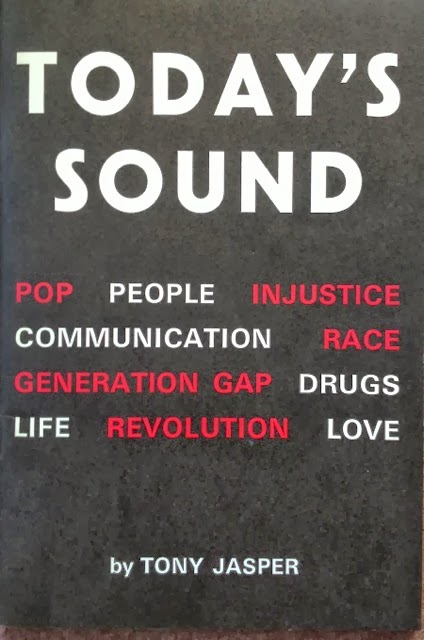
'Today's Sound' - learning from rock music (1970)

From Tony Jasper's Today's Sound (Galliard, Great Yarmouth, England 1970) a Christian teaching book. The teacher is encouraged to use rock songs and their lyrics to discuss contemporary morals, behaviour and ways of being. Thus we get some of the lyrics of  Martha and the Vandella's Dancing in the Street, transcribed thus, and followed with topics for discussion:

Cryin out in the world,
Are you ready for a brand new beat?
Summer's here and the time is right
For dancin' in the street.
They'e dancin' in Chicago, down in New Orleans
In New York City
All we need is music, sweet music,
There'll be music everywhere
There'll be swinging and swaying and records playing
Dancing in the street

Oh -- it doesn't matter what you wear,
Just as long as you are there.
So come on every guy, grab a girl,
Everywhere, around the world

Dancing in the street….

Describe the aspects of the present youth culture bought out in this song. Live out the song through movement, reduce the world, sing to it, love it, touch it, it's yours.

Take out a tape recorder, a camera, film camera and capture life as it's happening now. Think of ways and communicating the spirit of this song, your experiencings to the Other  generation.

For Eleanor Rigby the class is encouraged to draw pictures of  Eleanor Rigby and Father McKenzie and ask if our society is hard on those who never marry - "Do you find labels such as 'Old Maid' offensive?"

With Simon and Garfunkel's The Sound of Silence he suggests reading Waiting for Godot and The Loneliness of the Long Distance Runner for a greater depth of understanding . The Doors Light my Fire prompts a discussion of today's clothes 'do we wear them just for colour or so-called fashion or do we feel different in certain types of gear and find our personalities revealed through them? Are young people less inhibited than those of yesterday regarding sex?'

The Delaney and Bonnie Song (We've Got to) Get Ourselves Together leads to a discussion of the Christian religion. 'Has the Christian religion with its Universalist gospel a big part to play in a growing awareness by all people of their part in one big family called mankind? How can we ourselves take positive steps to enable all people to get together?' With The Beatles You've Got to Hide Your Love Away he suggests 'through mime and sketch act out situations which to the group seem likely to lead to misunderstanding and isolation...'

An interesting and slightly rare book - well meaning and very open to new ideas.  44 years ago - a vanished world.

Sunday, November 3, 2013

Bolan in Cyclops

From the first issue of the Norwich based literary magazine Cyclops (Wild Pigeon Press 1968). Other contributors included Jeff Nuttall, Snoo Wilson and Bill Butler. There is a full page portrait of Marc by Harriet Franklin, the wife of the magazine's editor Dan Franklin. Cyclops says of Marc: 'Sings with Tyrannosaurus Rex. First book of poems is appearing soon.' Indeed this poem appeared soon after in his Warlock of Love. Untitled (as it is titled) is  a prose poem so abstract it might turn into mist and float out to sea. It seems probable that rare and exotic herbs were consumed during its creation...Take it away Marc:

Tall as the truth the creature coughed in the clouds, 
feeding on mountain tips and the rare winged eagle lords 
that journeyed higher than the memory of man. Its claw, caked in mist and wishes, ripped at a pillar of fear 
masoned long ago by terrible forgotten Titans, to
 prevent the dreams of man from floating in the valleys 
of the diamond.
 Its eyes, like women and sand, shifted ever searching 
for the perilous horn of plenty. A foolish colossus 
it looked, ragged and unworshipped. Solitary on the 
roof of the world, a remaining nightmare in a plateau 
of fair thought.
It moaned and clumsily spewed spells of fear on the 
storm stallions grazing in the temple of pearls. And 
the years danced on. And all that moves returns to 
stone, eventually.

Sunday, July 14, 2013

I once danced with Ringo

Almost everybody has met someone with a good story about someone well known that they had met - the 'I danced with a man, who danced with a girl, who danced with the Prince of Wales' phenomenon. Here is one just received about Beatle Ringo Starr.The mention of Barbara Bach dates it in the early 1980s.


I got a minicab from Hammersmith to Heathrow and was chatting with the driver about Robert Tressell's The Ragged Trousered Philanthropists which he had read several times (I think I had a copy with me that I was going to read on the flight). As with so many other readers the book had radicalised him. He told me that he never called passengers 'Sir'. On that subject he mentioned that he had once driven Ringo Starr who told him he was the only driver he had ever had who did not call him 'Sir.' 

Intrigued, I inquired about the great (and irascible) Fab Four drummer*. He had driven Ringo and Barbara Bach from London to a studio in Manchester. Ringo spent most of the journey rolling and smoking joints. At the end of the journey he gave my minicab driver a £100 tip, which he said was still the best tip that he had ever received...and he never called him 'Sir'!

*Of whom John Lennon said  when asked if Ringo was the best drummer in the world --"He's not even the best drummer in the Beatles..." 

Tuesday, July 2, 2013

I nearly met….Mick Jagger

This is a new category -'I nearly met.' It could be very useful to future writers and biographers gathering info. Take it away Robin:


In fact, I nearly met him twice. About thirty years ago I was reliably informed that back in the late fifties, long before the Stones had been born, he and some mates used to practice in the front room of the home of our  neighbours, the Barton’s, in Woodland’s Park, a new housing estate in Joyden’s Wood, between Bexley and Dartford. I must have been about six at the time. The Bartons were our friends, but I knew nothing of rock music, or R & B, as Jagger and Richards would have called it.

 I don’t think you will find this particular bit of trivia in any account of Jagger’s early life, but Stone’s fans will know that for a few years in the late forties/early fifties Mick attended Maypole County Primary, Dartford Heath, which also happened to be my old school from 1957 – 62. Obviously, I didn’t meet him there , but fast forward to 2001, when prior to its being demolished to make way for new executive-style homes, Maypole hosted a reunion of alumni. Having discovered well in advance that this was to take place, I tried to contact the Stones management people with a view to persuading Mick to revisit his old school. After all, as I think I argued, ‘This could be the last time ‘. The great day arrived. I moseyed up Old Bexley Lane with hope in my heart, really expecting the great man to make an effort. Everyone was there—old schoolmates, some of who I actually recognised, and also some teachers, including the weird Mr T, who used to sit me on his knee (but that’s another story)—and there were old photographs too, possibly one featuring Mick as a boy.But no sign of the Stone’s frontman. Chatting to a few of my contemporaries I found that I was not the only one to be disappointed that evening.

I discovered a few weeks later that on this special day the Stones had been on tour in the States. Not really an excuse, I felt at the time. Mick could have sent a message. Today, the alma mater of Sir Michael (and indeed Keith), is now no more. Anonymous new housing stands on the site. The sprawling Bexley Mental Hospital, which had stood bang opposite, is also fancy executive homes . In my time, and undoubtably in Mick’s, patients used to sneak through the school gates and chat to the children.
I wonder if Mick got a song out of that….[R.M.R]

Wednesday, June 5, 2013

I once met...Dave Robinson

Sent in by a faithful jotter...an encounter with the mighty Dave Robinson of Stiff Records

It was the summer of 1979 and Stiff artistes—Wreckless Eric, Jona Lewie, and of course the Queen of Stiff, Lene Lovich, seemed to be everywhere. My neighbour in North Hertfordshire supplied marble fittings to the rich and famous. I occasionally helped him deliver these adornments locally. But this time we were going further afield---into trendy Battersea, where, according to my neighbour, a pop mogul called Dave Robinson wanted a marble bathroom delivered.


We arrived at the address, a large Victorian house which was in the process of being gutted. There were various people chatting in what looked like the sitting room. I didn’t recognise anyone who resembled Lene, but Eric, Ian Durie or Jona may have been there, as indeed could have been various members of Madness, who had yet to conquer the charts. At the time I don’t think I’d heard of Dave Robinson, but he was certainly present, and after we had struggled up the staircase with the various unwieldy stabs of marble, he duly signed the paperwork and we were off home.

My marble fittings neighbour was a crusty Tory in his early fifties, who, on the way back confided to me that he  thought Mick Jagger might dress smartly if he had wanted to impress someone like him. I think he was faintly proud that someone prominent in pop music had bought a bathroom suite from him. As for Mr Robinson, I sometimes wonder what he is doing now, 27 years on from the demise of his famous label. Can he still afford to live at that smart address in Battersea and if so do Suggs and Lene (who, incidentally is still touring) sometimes pop in for a chat.