Monday, July 14, 2014

I once met... Anna Pavlova (and Adolf Hitler)

Found in Words Etc.,: A Miscellany (Wordspress, Haslemere 1973) this piece by author, art teacher, botanist and curator Wilfrid Jasper Walter Blunt (1901 - 1987). His meeting with Hitler is admittedly fleeting, his meeting with Pavlova slightly  more substantial, but he tells both anecdotes well..

My Friendships with the Famous

Name-dropping is a pleasant and a fairly innocuous pastime, indulged in even by Shakespeare's Hipolyta: "I was with Hercules and Cadmus once…". At a party, when conversation is flagging, I sometimes like to electrify the company by saying, quite casually, "The first time I met Hitler was…". Then, before I can be subjected to an embarrassing interrogation, I change the subject.

No publisher has ever shown the slightest eagerness to publish a full-length book on my relationship with the Führer; yet I feel that the world ought no longer to be deprived of some account of my first (and alas! last) unforgettable meeting with him. I cannot, unfortunately, remember the exact date but it was some time in the year 1929. I had gone with a German friend to the Café Hecht, in the Hofgarten in Munich; Hecht means "pike", but little did I guess how big a fish I was about to land. At the table next to ours six people were sitting - three men and three women - and on that table was a funny little flag with a swastika on it; I assumed that they were adherents of some esoteric oriental religious cult. The men were dressed in brown (like our Capuchins), and one of them sported a ridiculous little moustache.


"Who on earth are those types?" I asked my friend - in impeccable German, of course.
"That one with the moustache", she replied, "is a man called Adolf Hitler. He has some kind of a political party here in Munich."
"Oh really?" I had never even heard the name that I was soon to hear only too often.
At that moment one of the women wanted to light a cigarette but had no match; nor, apparently, had any of the others. So the Moustache turned round to me

Saturday, July 12, 2014

Talking Beast. A Candid Enquiry..Part 1


Found - a fascinating book by a forgotten writer, Richard Ince (1881 to circa 1960). Although the author of 20+ books he has no Wikipedia page and there is not a lot about him on the web. He mainly looks up through his sister Gertrude's fortunate marriage into the engineering/ industrial dynasty De Ferranti. With her he edited her late husband's papers - The Life and Letters of Sebastian Ziani de Ferranti (Williams & Norgate London, 1934). He wrote novels,humorous works, biographies etc., One of his books, a collection of stories from 1926 At the Sign of Sagittarius, makes into Bleiler's Checklist of Science Fiction and Supernatural Fiction. The work we have scanned Talking Beast (Hodge & Co, London 1944) is a sort of self-help slightly ranting philosophical/ religious polemic, of its time with some ideas now unpalatable but a bold, fresh  work. The title comes from Sir Philip Sidney's Arcadia 'This Man, this Talking Beast, this Walking Tree.' Here are the first 3 chapters...


TALKING BEAST

A CANDID INQUIRY INTO THE NATURE

OF

HOMO VULGARIS

BY

RICHARD INCE

"A shop of shame, a book where blots be rife
   This body is . . .    
   This Man, this Talking Beast, this Walking Tree"
-Sir Philip Sidney's Arcadia

"To thine own Self be true

And it must follow as the night the day,
Thou canst not then be false to any man"
–Hamlet (1, 3, 78)


LONDON          EDINBURGH          GLASCOW
WILLIAM HODGE AND COMPANY LIMITED
1944


DEDICATION
To the memory of Archibald Weir,
to whose life and writings I owe so
much; in the hope that I have not
in this collaboration too seriously
misinterpreted the essence of his vital
message


PREFACE

  This book, written during the years of war seems to me have a pertinent bearing on the conditions of our time. It does not deal directly with reconstruction in the political, or religious spheres, although, I imagine, the unprejudiced reader will come from its disquieting awareness of what is and what be. • It is not concerned with any rearrangement of goods in the market place. It is surely the men and women who stand behind the booths that should claim attention. Getting and spending we lay waste our powers, wrote Wordsworth. Life is larger than any religion, any philosophy, any science. And the only experience we can have of life is that which our own consciousness, feeble and flickering, brings to us. All I ask

I once met….Sir Felix Dennis

The sad recent death of amateur poet, multimillionaire media mogul, and manic tree planter reminds me of the day I interviewed him back in 2008. Preparation is everything and knowing that this most eligible bachelor was rather fond of attractive young ladies, my magazine sent me to meet him with a pretty Dutch photographer in her twenties whose dress of choice was a very clinging all-leather cat suit. I can’t for the world think why she chose this particular outfit, but there you are.

In the Forest of Dennis

With Oz defendants Neville and Dexter
Anyway, we arrived for the interview at the office below his penthouse flat off Carnaby Street, which he still rented after four or more decades. While I sat on a huge couch next to an aquarium, which seemed to take up most of one side of the large but rather dingy room, the photographer was shown upstairs to take pictures of Dennis’s superb  library of mainly modern firsts. When the great man arrived late from a generous lunch he was clearly in a good mood, as you might say. This was confirmed when, after adjourning to his office, I prepared for the interview by dropping my tape recorder and allowing all the batteries to fall out. ‘Hah! Hah! Hah! he gleefully exclaimed, ‘Another technophobe’ . I wasn’t, of course, but I knew that he was. I’d been warned that despite the fact that he owned several high-tech magazines, he wasn’t online and had no mobile phone. Nor, despite publishing for car-mad young men, did he drive. I also suspected that he had health problems when he soon after reached for several small bottles in his desk and swallowed a handful of pills.

The interview went remarkably well. There was to be a lot more raucous laughing from his direction and eye-popping amazement from me. We were there principally to discuss his latest book, How to Become Rich, but, of course, I was much more interested in his early hedonistic lifestyle and book collection. On the latter topics he did not disappoint. It appeared that long before the OZ trial one of his principal ambitions had been to defy the mores of his middle class childhood in Kingston on Thames. He dropped out

Friday, July 11, 2014

Heffers---a life in books


Everyone who has ever lived or studied at Cambridge knows Heffers. It’s the big cheese bookseller in the city and is an international brand too. Around 1996 the company, which then employed around 300 people, issued a brief history, which has been useful in compiling this profile.

The Heffer family originally came from Grantchester, celebrated by Rupert Brooke and now the home of well-known storyteller Jeffery Archer. In 1876 William Heffer opened up a stationery shop in Fitzroy Street, just east of the city centre, where his success with a sideline of hymn books, bibles and general school books, convinced him that he ought to focus more on bookselling. Further success resulting from 25% discounts for cash and an expansion into academic and general titles, made it possible for Heffers to relocate to the city centre in Petty Cury.


Heffer then became a printer—and books printed by the company from the early twentieth century until 1987, when a management buy-out created the Black Bear Press-- can often be found, especially locally. Following William’s death in 1928 the company, with its three distinct areas of operation, was steered forward by son Ernest, and grandson Reuben, who became an influential figure in University and city life. Further success, especially internationally, followed the appointment as General Manager in 1964 of Cambridge graduate John Welch, who had no experience of bookselling and was not even a family member.

Heffers remained in Petty Cury until the late 1960s, by which time the decision of the City Council to redevelop the street, and the continuing expansion of Heffers as a business, made it necessary for the company to relocate once again. This time the decision was made easier by the offer by Trinity College of premises in Trinity Street once occupied by a grocer. The site was redeveloped from scratch and today, the design of the shop that has been called ‘one of the first and largest custom-built bookshops in the country’ is admired internationally for its bold simplicity.


Doubtless over the decades many students have supplemented their grants by working the odd Saturday at Trinity Street, but few have gone on to achieve the success of children’s writer Pippa Goodhart,

The Rolls Royce of Bookplates

Found -- the bookplate of Charles Stewart Rolls  featuring early sporting motor-cars to foreground with illuminated lamps, the moon rising behind an imposing country pile, and balloons ascendant in the sky above; inscribed “Charles Stewart Rolls” below, and with the coat-of-arms of the Baron Llangattock surmounting top centre with family motto “Celeritas et Veritas” (Speed and Truth)measuring 12 x 9cm. About 1905. Rather valuable - a clean one made over a £100 at Bonhams in 2013. The artist was known as WPB  (Barrett) and he produced several hundred bookplates, mostly for the landed gentry, featuring the house, the library and the pastimes of customers who ordered them at bookshops like Bumpus.

Charles Rolls was of course the co-founder (with Henry Royce) of the Rolls Royce car firm. He stood 6 foot 5 inches and died  young -he was the first Briton to be killed in a flying accident, when the tail of his Wright Flyer broke off during a flying display in the Southbourne district of Bournemouth, England in 1912. He was 32. He came from money and with a loan of £6600 from his father (Baron Llangatock) he set up one of the first car dealerships in London.

Wednesday, July 9, 2014

The Secret of Time Travel

Found - a booklet from 1984 by David Savage The Secret of Time Travel (Finbarr Book, Folkestone.)

The lines near the start of the book:  'If we have lived on the Earth before, the body cells must ALSO be equipped with, or have access to, all the data about our other lives on Earth' may require a couple of largish leaps of faith, but time travel sitting comfortably at home and without the aid of a complicated Wellsian metal time machine is an attractive proposition, so it may be worth persevering.

The book is only 15 pages in length and the author gets down to the real secret at page 8. Other Finbarr books included: Making Money with Magick, How to Contact God, Winning with Witchcraft, Mindflow and The Secret of Immortality. The booklet came from the vast library of Dr. M. H. Coleman, a writer on the occult and psychic matters. He collected over 4000 books on these subjects but was a confirmed sceptic and  set out to prove that there are definitely not more things in heaven and earth than in Horatio's philosophy...

"Your Body Cell"
.
The secret lies within your body cells. These are the structural units of all living organisms. The body is made up of a countless number of these microscopic cells. Scientists now accept that for the body cells to function, every single cell knows everything about you from eye colour to what you like the taste of. It is accepted SCIENTIFIC FACT that every single body cell of yours is equipped with all the data about you. This made me think. If we have lived on the Earth before, the body cells must ALSO be equipped with, or have access to, all the data about our other lives on Earth.


From the 1970s TV series The Time Tunnel

THE SUBCONSCIOUS MIND.
The mental processes outside the personal awareness of an individual are controlled by the subconscious mind - the mind which regulates our heartbeat, bloodflow, and body cells etc., on the subconscious level

Hunting panthers in India (1920s)

Found in an unpublished  typescript -a real life account of big game hunting in India- the author was almost certainly Lieutenant Colonel J. W. Wray. The climax is worthy of Henty or Buchan, otherwise it is a good hunter's tale, completely of its time...The manuscript was in an envelope with 3 other chapters addressed to him at 'The Croft, Guildford' and he is known to have writtenWith rifle and spear : reminiscences of Lt.-Col. J.W. Wray. COPAC gives his dates as 1851-1924 and record this book as being published by The General Press, Ltd.,. They estimate the date as 1925. Certainly these accounts mention rifles and spears, Wray was a dedicated game hunter. The manuscripts came from a couple of very old soldiers - Basil and Russell Steele.


No copies of the book are available and it has not been digitised, apart from an earlier chapter at Jot. Web archives reveal he was in the 108th Foot Regiment and he was a member of the Northumberland and Northern Counties Club. Punch mentions him and his wife in 1916 - the victim of a Pooter like misprint: 'Mrs. Wray entertained the recruiting staff, numbering £21, to tea at Brett's Hall, Guildford, on Thursday.' They add 'Sterling fellows obviously'.


TWO PANTHERS

     One day in October when everyone was feeling weary of life and grumbling at the steamy heat after the thunder showers that are so frequent in that month, I slipped away by myself with my horse and pony and spears and an 80 lb. tent, with a view to putting in 3 days in the jungles after pig or even jackals. My rifle at that time had gone to the Armourer Serjeant to be brown and I therefore borrowed a friend's muzzle loading rifle so as not to be entirely dependent on my shot gun for any big game I might happen to come across, for in those delightful jungles to which I look back with such intense happiness and affection one never knew exactly what surprises might be in store.

     I had at that time two shikarris (or trackers) in my pay - one for boar - the other for tiger

Monday, July 7, 2014

Early Days of T.M. in London

Found, a leaflet from the early 1960s issued by the London HQ of Transcendental Meditation or 'The Spiritual Regeneration Movement Foundation of Great Britain' as it was known then. The alphabetical phone number HYD 6296 puts it before 1966, before the movement, under Maharishi Mahesh Yogi, became a major force with the involvement of The Beatles and other celebs in 1967...


THE ROLE OF THE INDIVIDUAL IN TODAY'S WORLD SITUATION

The question of what can be done to reduce international tension and avoid the disaster of war is one that weighs upon the hearts and minds of us all. But few of us ask "What can I do?" Because it seems impossible for an individual to do anything; we are coming to regard ourselves as no more than helpless passengers on a vast liner that is about to sink.

Are we?

For the forest tobe green, the trees  must  be green. War can-and will-break out in a World that is prepared for it -prepared by the presence everywhere of an atmosphere of anger, lies, and hostility based upon fear. On the other hand, war could not and would not happen in a world peopled by individuals  at peace with themselves.

When we let fear provoke us into argument and hostility - even if only over our "rights," vanities and prejudices-it does not occur to us that our quarrels could have anything remotely to do with the peace of the world. And yet it is the sum, the mass, of these infinitely small conflicts which, put together, help to make up a total atmosphere of tension and hostility. 

Sunday, July 6, 2014

Very short poem from Spike Milligan

Found in Words Etc.,: A Miscellany (Wordspress, Haslemere 1973) this very short poem (above) by the British comedian Spike Milligan A Poem for the Lonely. Spotify also has a recording of Spike Milligan reading this excellent poem along with another inspired piece Orchids in my Glass. It goes like this:

We have cracked the midnight glass,
And loosed the racketing star-crazed night
The blind harp sings in the late firelight
And your hand is decked with white promises.
What wine is this?

There are orchids growing in my glass,
Good God, I'm pissed.


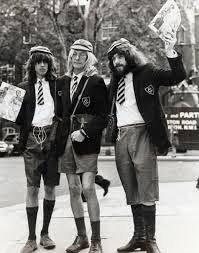
Spike with the young Prince Charles and fellow goon Harry Secombe

Saturday, July 5, 2014

Barbara Taylor Bradford - the early works

 The best-selling English novelist Barbara Taylor Bradford's early works were mainly  about interior decoration and 'homemaking.'  They include Decorating to Please Him (How to be the Perfect Wife Series) and Etiquette to Please Him (How to be the Perfect Wife Series). They appeared between 1968 and 1969. BTB's 'perfect wife' paperbacks seem to be aimed at the Stepford Wife archetype and they came out when The Female Eunuch and The Feminine Mystique were on the best seller lists. Nowadays they have a distinct vintage flavour and some dealers even try to get big bucks for them at Amazon. Generally BTB collectable prices for her novels are on the low side, romantic fiction being one of the least collected genres. The Marie Corelli of our age* she is said to be worth £150 million+. Sadly the story about her heating the water in the lake on her estate, so that her pet swans might paddle about in comfort during the winter months, may not be true - BTB says the previous owners of the property had installed it.

Of course many best selling writers wrote very ordinary, forgotten books before they struck gold - Neil Gaiman's rare and valuable book on the boy band Duran Duran, Arthur Bryant's Unfinished Victory (it showed Nazi sympathies in 1940 -he tried to destroy most copies, hence the book's rarity.) Dan Brown's 187 Men to Avoid: A Survival Guide for the Romantically Frustrated Woman (written with his wife in 1995) and Dean Koontz porn paperback from the 1960s Hung! Not forgetting the great thriller writer Ernest Bramah's 1894 debut English farming and why I turned it up. [Suggested  by JK - for which much thanks]

* Her earliest works were of a religious bent like those of Marie Corelli  - in 1968 she wrote Children's Stories of the Bible from the Old and New Testaments.

Friday, July 4, 2014

Venereal Disease wall poster

An uncle used to talk about films shown in the army to the troops about the perils of Venereal Disease during WW2. They were pretty graphic and designed to discourage soldiers from putting themselves at risk…This wall poster may date from about that time and was probably displayed in a clinic where the dreaded silver and yellow tubes were dispensed. Medicine has moved on. Note the touching faith in soap - with 5 minutes lathering recommended 'from belt to knees.'

Thursday, July 3, 2014

The Ghosts of Glamis


Found -  The Ghosts of Glamis - a typescript, apparently unpublished, from around the 1960s. Glamis is the seat of the Queen Mother's family, the Bowes-Lyons, and is said to be the most haunted castle in Britain. There is the Grey Lady who haunts the chapel, a tongueless woman haunting the grounds, a young black servant boy haunts the seat by the door to the Queen's bedroom, also the ghost of the gambler and hell raiser Earl Beardie has free range of the house (he lost his soul to the devil in a card game). There are more. The castle is also mentioned in Shakespeare's MacBeth, and the murder of King Malcolm the II is supposed to have taken place in one of the rooms.This seems unlikely as the castle dates from the 14th century and the murder from the 11th century. The typescript is of unknown provenance but seems to have been written for publication...

The Ghosts of Glamis

     Glamis Castle is certainly the most noteworthy castle in Scotland, and it held in special pride and affection by the Scottish people. The long records which tell of its history as a Royal residence, the romance of the long ownership by the Lyon family, the many legends and ghostly happenings which are connected with it are fittingly expressed in the building itself. Glamis - that most haunted and stately old pile - is the very embodiment of the castle of romance.
     Still proving the validity of its ancient boast that it is the cradle of kings, it has, in our day, added to its memorable past by having been the childhood home of the Queen Mother, whose father, the late Earl, was the 14th of the line of Strathmore and Kinghorne.
     Legend, as well as history, has enriched the story of Glamis.

Wednesday, July 2, 2014

Sir John Betjeman's last poem

Found - a broadside poem poem of twenty lines in honour of the famous old central London church St.Mary-le-Strand. It dates from about 1980 and is signed by John Betjeman in what one cataloguer calls his 'frail hand of old age'. It was published from his address at 29 Radnor Walk, SW3 and was part of the campaign to raise funds for the restoration of this masterpiece of baroque.

This copy came with a letter from the church to a professor at Ilorin University, Nigeria. The secretary of the trust, a Ms Anne Butters, thanks him for his £20 donation and informs him  that JB's publisher, John Murray, says that this was the last poem he ever wrote. So far unknown to 'go ogle' (as he may have called it) and not in any major UK library, it is decidedly scarce...
A single sheet of imitation parchment paper, printed in black on recto only. 296 x 206mm.


    St.Mary-Le-Strand

Shall we give Gibbs the go by
Great Gibbs of Aberdeen,
Who gave the town of Cambridge
The Senate House Serene;
Every son of Oxford
Can recognise he's home
When he sees upon the skyline
The Radcliffe's mothering dome.
Placid about the chimney pots
His sculptured steeples soar,
Windowless he designs his walls
Above the traffic's roar.
When ever you put stone on stone
You edified the scene,
Your chaste baroque was on its own,
Great Gibbs of Aberdeen.
A Tory and a Catholic
There's nothing quite so grand
As the baroque of your chapel
Of St Mary in the Strand.

A Very Private Dinner, 1912

In the year of the Titanic and the Antarctic disasters here is the handwritten menu --found among the papers of Ernest B Rubinstein, of a special meal—possibly a marriage feast—held by members of the Rubinstein and Laurance families at 42, Boundary Road, South Hampstead.

Not that remarkable you would think, although on closer inspection some of the dishes are unusually named -- 'Sole distrait a Laurance,' 'sauce Agnes', 'poires matrimonial,' 'gelee avec raisin d’etre'. If the dinner was held to mark a marriage—and 'poires matrimonial' strongly suggests this-- then it was a marriage that produced one of the most original children’s writers of the twentieth century.

That writer was Patricia Rubinstein, aka Antonia Forest (1915 – 2003 ), who was born three years after the dinner, later attended South Hampstead High School, just a few minutes walk from 42, Boundary Road, and who learned her love of literature, and particularly drama, from her stage-struck father, Ernest B. Rubinstein, whose signature heads the list of diners that appears on the reverse of the menu.

Others signatures include that of Kate Rubinstein, an Irish Protestant whose marriage to Ernest introduced her into a Jewish circle in Hampstead whose members were to contribute their signatures and messages to Patricia’s autograph book of 1924—another item found among the Rubinstein papers. Two other Rubinstein signatures on the menu were probably those of Ernest’s siblings.

It could be said that Antonia Forest guarded her privacy every bit as jealously as J. D. Salinger did his own. For most of her life she lived quietly in Bournemouth. Even her devoted fans did not know her real name and in one of her very rare interviews she studiously omitted any meaningful details of her parentage and early life that might help a biographer. Because of this, the career of her father as a prominent theatre critic, versifier and amateur playwright, has remained shrouded in mystery---until now. But we can at least surmise that the much more prominent man of the theatre, Harold Rubinstein (1891 - 1975), who as a lawyer defended Lady Chatterley’s Lover in 1960, was a relation-- possibly a nephew.[RR]

Tuesday, July 1, 2014

Angels at Mons

Found - a small thin 4 page pamphlet Angels at Mons printed in Felixstowe, England about 1920. Its price was ninepence for a 100 and it was almost certainly for distribution in churches. Ours was found in a missal.

There is much elsewhere about the angels that are said to have appeared on the WW1 battlefield at Mons. Arthur Machen's 1915 book The Bowmen and Other Legends of War really started the legend.

Historian A.J.P. Taylor was so impressed by the evidence then available that he felt confident referring to Mons, in his 1963 History of the First World War, as the only battle where “supernatural intervention was observed, more or less reliably, on the British side.”

The Penguin Encyclopedia of Horror and the Supernatural says of Machen's book: "During Machen's lifetime 'The Bowmen' was easily his most influential work of fiction, in ways he never predicted. First published in a 1914 Evening News after the Battle of Mons, it told how British troops, their retreat cut off by the Germans, were miraculously rescued by a ghostly St. George and his bowmen of Agincourt. Widely accepted as true or as a genuine legend, the incident is regularly referred to even today, in books of occult lore and oral histories of the Great War." Fortean Times has this great story of hoaxes and mayhem around the legend with a report on a Hollywood movie that was going to be made on the angels with Marlon Brando.


Angels at Mons


Testimonies of men
who saw them.


"Your young men shall see visions. ” Joel 2 : 28.
" I will show wonders in heaven above and signs in the earth beneath. " Acts 2 : 19.


  Mrs A. L. Cooke, 62 The Grove, Bedford, in " The Record " of Sept. 9th, writes :–
  " On a Sunday evening quite recently the Vicar of Holy Trinity Church, Bournemouth was preaching a sermon about Angels. Two officers present followed him into the vestry and told him how much interested they had been with his sermon for said they:–We were at the Battle of Mons and saw the Angels.

  In another part of Bournemouth lives a maiden lady, who is an aunt to the officer who says that the Vision of Angels at Mons has changed his whole life, that he did not believe the Bible before