Monday, February 17, 2014

The Air of Bloomsbury

Virginia Woolf & Clive Bell 1909
Found in a Times Literary Supplement from 1954 this anonymous review of J.K. Johnstone's The Bloomsbury Group. Clive Bell did not agree with much of the information or opinions in this article and wrote a letter to the editor in response, which appeared a week later. Oddly he wrote later that the review "is by far the most intelligent and penetrating piece that has been written on the subject." It is obviously by someone very familiar with the group. The Bloomsbury industry did not start in earnest until 1967, the year of love,


with Michael Holroyd's monumental biography of Lytton Strachey. Interesting to note that Maynard Keynes was very slightly looked down on by the set - possibly this is something Bell addresses in his letter.


THE AIR OF BLOOMSBURY

Mr. Johstone's The Bloomsbury Group is a respect-worthy book. lt often shows imaginative insight, and always long and sincere thought. Sometimes we detect a faint aroma of what Mr. Forster calls pseudo-scholarship, but this might well have been far stronger and more frequent, considering that his study of the Bloomsbury Group, as he calls it, was first conceived as a Ph.D. thesis. A pseudo-scholar, Mr. Forster explain (adding endearingly that this is what most of us are) is one who moves around books and not through them. “Books have to be read," he adds, characteristically,"worse luck for it takes a long time; a few savage tribes eat them, but reading is the only method of assimilation revealed lo the west. The reader must sit down alone and  struggle with the writer. . . ." And this Mr. John- stone has done faithfully and well, almost throughout. His book is mainly a study of the three Bloomsbury writers, Lytton Strachey, the biographer, and the two novelists, Virginia Woolf and Mr. E. M. Forster... [the reader]will surely find that Mr.J increases his insight  into their art, and their unobtrusive mastery of pattern and design. Indeed Virginia Woolf, he shows, invented almost a new novel form to express her "experience of  living,"...


Mr. Johnstone's book has one main thesis. He sets out to show that the members of the Bloomsbury Group had common values stemming from an original gospel, the early Cambridge philosophy of G. E. Moore formulated in his Principia Ethica,and published in 1904. Moore himself stems from the Cambridge humanists, Lowes Dickinson and McTaggart, the philosopher, and he links up, too, with that mysterious Cambridge body,the Society - with a capital S, whose members were known as apostles. These included many figures, distinguished in their day, among them Leslie Stephen & Henry Sidgwick. Sidgwick describes the tradition of intimate discussion in the Society, which Bloomsbury was later to inherit.

Sunday, February 16, 2014

Care of Books

From Newnes Household Encyclopaedia (London, 1931.)

Books. To preserve from insects.
If books are occasionally dusted over with a mixture of white pepper and powdered alum they will be insured against the attacks of insects.

A more modern recipe, taken from anecdotal evidence, is one to rid a book of unpleasant odours (especially tobacco smoke). Place the book in a container of wood chip based cat litter so that is submerged and leave it there for 48 hours. The idea is that the chips will extract objectionable smells. Books reeking of tobacco have become hard to sell...

Snail recipe

From Les Boissons et Liqueurs economique by Etienne Ducret (Paris, c 1890.)
This was sent in by loyal jotter and foodie RR.

A recipe for snail syrup.
First: pound together very finely:500 grammes of snails and 500 grammes of sugar ; then, pass this paste through a fine sieve.
Second: combine 500grammes of sweet almonds; 150 grammes of bitter almonds. Pound them with 500 grammes of sugar and 125 grammes of water. Dilute this paste in 825 grammes of water. Strain vigorously.
Third: add to this emulsion your mixture of sugar and snails that you dissolved in a bain marie on a low heat.
Fourth: when the sugar has melted add a certain quantity of orange flower water.
For consumption and bronchitis, 3 to 6 teaspoonfuls of this syrup is recommended per day.

Only ingredient missing------puppy dogs’ tails. Incidentally, M. Ducret (1829 – 1909), as well as being a gastronome (he also wrote a book on patisserie) seems to have been a literary hack in fin de siècle Paris. His book contains several recipes for absinthe.

Friday, February 14, 2014

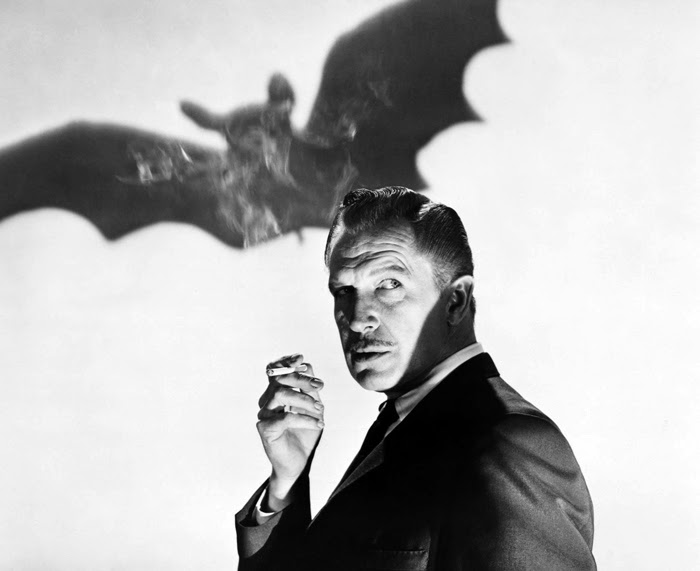
Vincent Price sees a ghost..

Found in an anthology of  supernatural encounters by the famous - I Saw a Ghost edited by Ben Noakes (Weidenfeld, 1986)- this account by Vincent Price.

On 15 November 1958 I had an extraordinary glimpse of the unknown  whilst on a flight between Hollywood to New York   I was immersed in a book**  for most of the journey, but at one point, glanced idly out of the window.  To my horror I saw huge, brilliant letters emblazoned across a cloud bank spelling out the message "TYRONE POWER  DEAD".  it was a terrific shock, I began to doubt my senses when I realised that nobody else on the plane appeared to have seen them, but for a few seconds they were definitely there, like huge teletype, lit up with blinding light from within the clouds.  When I landed in New York I was told that Tyrone Power, had died (suddenly) a couple of hours earlier.

**In one account the book is a classic French novel - which might explain something. Also worth noting is that Power was a close friend of Price. The book bears a presentation to the artist Ronald Searle from Noakes. RS contributes a similar piece about being woken up in the South of France  by Laura West Perelman the late wife of his friend Sid Perelman (and sister of Nathaniel West) who announces to him 'Sid is Dead' - the next morning he receives a call telling him that Perelman had been found dead in his hotel room in New York during that same night.

Thursday, February 13, 2014

Manners in the Drawing Room -- some 'don'ts'


From an undated but late Victorian self-help / etiquette book called Don't: A Manual of Mistakes and Improprieties more or less prevalent in Conduct & Speech (Ward, Lock, London circa 1890). The author is noted as 'Censor' - now known to be Oliver Bell Bunce. Much of the advice still holds, e.g. about reading a book in company...in 2014 it  would be about perusing a smartphone.

DON'T repeat old jokes or tell time-worn stories. DON'T make obvious puns. An occasional pun, if a good one, is a good thing; but a ceaseless flow of puns is simply maddening.

DON'T be always on the look out for opportunities of making jokes. For a man, to be constantly straining after witticism is to render himself ridiculous, and to annoy the whole company.

DON'T, if you think you are a clever mimic - and many persons entertain that idea with more or less basis of fact - be very ready to exhibit your powers in society. Few persons like to have their peculiarities noticed; and it is almost certain that some officious, and well-intentioned friend, will let B know that A gave an admirable (or execrable) imitation of him at Mr. So-and So's dinner party.

DON'T respond to remarks made to you with mere monosyllables. This is chilling, if not fairly insulting. Have something to say, and say it.

DON'T appear listless and indifferent, or exhibit impatience when others are talking. Listening politely to every one is a cardinal necessity of good breeding.

DON'T be conceited. DON'T dilate on your own acquirements or achievements; DON'T expatiate on what you have done or are going to do, or on your superior talents in anything. DON'T always make yourself the hero of your own stories.

DON'T if you have travelled, be continually talking about what foreign places you have seen, or the adventures you may have met with; and DON'T consider the people of foreign places to be necessarily inferior to your own countrymen, because their national habits are different.

DON'T be sulky because you imagine yourself neglected. Think only of pleasing; and try to please. You will end by being pleased.

DON'T show repugnance even to a bore. A supreme test of politeness is submission to various social inflictions without a wince.

DON'T, when at the card-table, moisten your thumb and fingers at your lips in order to facilitate the dealing of the cards. This common habit is very vulgar.

Wednesday, February 12, 2014

The Shortbread Eating Primer

Found, a genuine British schoolroom memento - a 'treated' copy of  Benjamin Hall Kennedy's Shorter Latin Primer recently described by Mary Beard in The Independent as 'the Rolls Royce of textbooks'. Certainly it is one of the longest lived -120 years after its publication it is still the best-selling book in the Classics section of most college bookshops. As Mary B says 'It took only the addition of a few extra letters and lines to turn The Shorter Latin Primer into The Shortbread Eating Primer.'

This copy (1938) comes with  serious schoolroom wear and ink blotches worthy of Molesworth...

Tuesday, February 11, 2014

Bullingdon Club 1935 and 2013

Found in the window of an antique shop a photo of the 1935 members of the ultra privileged Oxford University Bullingdon Club -an exclusive society noted for its grand banquets and boisterous rituals, such as 'trashing' of restaurants and college rooms. It is mentioned in novels by Waugh, Powell, Raven etc.,


Membership of the club is expensive, with tailor-made uniforms, regular gourmet hospitality and a tradition of on-the-spot payment for damage.Their rallying cry is 'buller, buller, buller!' and their ostentatious display of wealth attracts controversy, since many ex-members have moved up to high political posts - UK PM David Cameron, London mayor Boris Johnson and Chancellor George Osborne. They are seen to embody an upper class mentality that could have no inkling of how ordinary mortals live. Certainly the 1935 members look highly patrician, snobbish even arrogant.

Bullingdon Club members in London 2013

How much has changed 78 years later? Former members include Edward VII and VIII, Frederick IX of Denmark, Prince Leopold, Duke of Albany,Prince Paul of Yugoslavia,Rama VI, King of Siam, David Dimbleby,Lord Randolph Churchill, Darius Guppy,Peter Holmes à Court, John Profumo, Cecil Rhodes, Nathaniel Philip Rothschild, Charles Spencer, 9th Earl Spencer, Alexander Thynn, 7th Marquess of Bath and Felix Yussupov. The 1935 crowd appear to have no famous members, just the usual aristocrats, landowners and gilded youth...

Sunday, February 9, 2014

Poor Mr Kitching…


The worship of celebrity is certainly nothing new. Autograph collecting in Britain started to be a craze from the mid Victorian period, possibly due to the cult of personality that grew up around Prince Albert and Alfred Tennyson. If this letter from sometime MP W. S. Shirley is any indication, even the autographed letters of sitting and former members of parliament, however comparatively modest their achievements,  became the target of collectors.
It would seem that Shirley’s lawyer friend, Alfred Goodall, was one such autograph-hunter, and so was sent whole letters that Shirley had accumulated while sitting in the Commons as MP for Doncaster. Here’s what Shirley wrote in his undated covering letter:

Dear Goodall,

One or two autographs you can have viz:
S. D. Waddy, Q.C. M.P.
A. G. Kitching ex M.P.
Sir Walter Foster, M.P.
B. Pickard, M.P.
 All, except Kitching’s will improve in value as time goes on…

Oh dear! What can Mr Kitching have done to have gone down so low in Mr Shirley’s estimation ? A bit of delving, however, reveals that Shirley was a pretty accurate talent spotter. S.D. Waddy was already a busy QC and went on to establish himself as a respected writer on theological issues. Sir Walter Foster was already a man of substance. But it is with B(enjamin) Pickard that Shirley hit gold.

Friday, February 7, 2014

E.H.W. and the Telephone

Edward Harry William Meyerstein (1889 – 1952) was an English writer, poet and scholar. He wrote novels, poetry and short stories, also a Life Of Thomas Chatterton.His book Bollond and Other Stories is a posthumous work with an introduction by his friend Rowland Watson. It has this to say about E.H.W. and the telephone. Interesting to note that as late as the 1930s it was regarded with suspicion and of no possible use...

It was only at the approach of middle age, after an agony of self-examination, he submitted to the telephone and typewriter. When he adopted the telephone he wrote to R. N. Green-Armytage on November 19th, 1932:

"I am glad you think the installing of the telephone stimulates hope. I have not made a single call or received one, save from the telephone exchange on the day it was installed. There it stands like a revolver at my bed. It will be interesting to see what the bill for no calls will be. A publicity-seeker might make a good letter to The Times out of that. When my name is in the telephone book I shall await the experience of blackmail with some avidity - but at present there is silence, as of the dead."

It was another picture in the autumn of 1946 when I found him in bed, only slightly unwell. Lying on his back, his toothless mouth rapidly opening and shutting, a wicked twinkle in his eye, thoroughly happy, he said, pointing to the instrument: "That thing is a Godsend. I lie in bed, pull the strings and there is a constant procession up my stairs with gifts of food." Mark well the year - 1946!

As for the typewriter E.H.W. was known to make such a row on it while writing that disturbed neighbours used to knock on his door  to see if he was all right - "…he always bowed his tonsured head, with a polite answer:'Thank you for enquiring. I am in the throes of composition.' "

Rachel Swete Macnamara

An interesting romantic thriller Cock Angel by Rachel Swete Macnamara published by Hurst and Blackett (London circa 1955) We don't normally do smut at jot101, not out of piety but because there is more than enough elsewhere. However this cover was irresistible and it is hard to believe that the dubiousness of the title was not spotted at the time. The book first appeared in 1928 and was re-issued in the 1950s with this mildly suggestive jacket. Rachel Swete Macnamara seems to have gone in for titles with a slightly  religious reference - her other works include Pagans Limited, Torn Veils, Stolen Fruit, Burnt Dishes, Jealous Gods, Seed of Fire and The Trance... 


The plot, summed up on the flyleaf, goes thus:

 Charles Revel falls deeply in love with the wife of a celebrated film star, who shortly afterwards meets his death by drowning. After six months Charles meets her in London and, following a swift wooing, marries and takes her to the family house, where she soon feels herself over-powered by inquisitive relations and the memories of her first impetuous, though faithless, lover. How she eventually breaks under the strain, and the ultimate result, form the ending to a very engrossing novel.

Wednesday, February 5, 2014

The Princess and the Pauper---seeing is not always believing

Sent in by loyal jotperson RMH. It is worth noting that despite his suggestion HG is not totally forgotten and, in fact, is quite saleable. He was also, at one time, collected by Teflon man Kenneth Baker and other lesser lights...


Here’s a puzzle. Look at the cover of this oddity recovered from a job lot two years ago. Open the volume and seemingly, what we have is the printed programme notes of a comic drama performed at ‘The Theatre Royal’, somewhere or other, bound in with a carbon copy of the script. Looking more closely we find that the venue is Government House and the reviews, which are from Canadian newspapers mainly from the Ottawa district, are far too facetious to have been genuine. Further research reveals that, despite the highly professional quality of the programme, everything suggests that the ‘extravaganza’ is purely an amateur production. A little more delving tells us that most of the players are members of the same aristocratic family—in fact sons and daughters  of the fourth Earl of Minto, Governor General of Canada, then a British colony.

We have already noted that the playwright was ‘Col. D Streamer’ and the small print reveals that this supposed army officer (who also directed the play) was the author of Ruthless Rhymes for Heartless Homes, which had appeared a year before the play was performed. By now, most fans of ‘sick’ humour will have twigged that Col. D Streamer was the pseudonym of one of Britain’s most admired comic poets--a man worthy to stand by Thomas Hood and Edward Lear-- much darker than the former and just as inventive as the latter. We are talking, of course, about Harry Graham, then just 26, who was aide de camp to Lord Minto and a close friend of the Minto family (pic below).


The Governor General and Graham, who were both old Etonians, got on famously, but it is not known what his employer thought of such a ‘ruthless rhyme’ as the following: 

Billy, in one of his nice new sashes
Fell in the fire and was burnt to ashes
Now, although the room grows chilly
I haven’t the heart to poke poor Billy   

However, it is likely that Minto took the play’s rather disparaging references to Canada, and Ottawa in particular, in good heart. In his turn Graham had the script ( which was probably his own )and accompanying programme notes specially bound and presented to Lady Minto at Christmas, 1900, possibly just after the play hit the Theatre Royal. Incidentally, this grandiose- sounding venue was probably just a modest lecture hall within Government House, specially adapted for this one performance by family and friends.

In the following year Graham departed for the Boer War. He returned unscathed in 1902 for a second term as Lord Minto’s right hand man. Before his death in 1936 he went on to publish more comic verse  and compose many more comic dramas, most of which, like The Princess and the Pauper,  are now totally forgotten. 

Tuesday, February 4, 2014

Ghosts as a symptom of dyspepsia

Frankfort-Moore in his Italian Home
From A Mixed Grill : a Medley in Retrospect / by the author of "A Garden of Peace". London : Hutchinson, [1930.] The anonymous author was, in fact,  Frank Frankfort Moore (1855–1931) an Irish dramatist, biographer, novelist and poet. Born in Limerick, Ireland, Moore worked as a journalist (1876–92) before gaining fame as an author of fiction. The frontispiece of this book shows him in his 'Italian Home' - this was actually a house in St. Leonards called 'The Campanile' filled with Italian artefacts that was on sale  in 2010. On the subject of ghosts he is somewhat sceptical but most subjects, as the title implies, are seen from a slightly  gastronomic viewpoint:


All the great ghost-seers on record have been also eminent dyspeptics - men and women who were deficient in pep or who had ruined their digestions by irregularity in diet or by a wrong diet. The ghost is really a symptom and it is rightly so regarded by the medical profession. We all know the sort of person who is  associated with a ghost story - the ethereal girl like the sister of Sir Galahad who saw the Holy Grail - "I thought she might have risen and floated" - that girl has really risen and floated in innumerable ghost stories - the type of girl on whom that form of rash, known as the stigmata, has from time to time appeared. This may be the ghost of indulgence. In the days of gluttons there was a glut of ghosts, and there are few men of middle age to-day who have not had some experience of the man whose ghosts take the questionable shape of blue monkeys pr black cats, sometimes even of such minor crawling things as spiders or black beetles in natural colours, or, more frequently, snakes of no recognised classification. These are all the result of an over indulgence in the drug known as alcohol. Other drugs such as opium or cloral are productive of more pleasing spectral shapes; but this class of ghost has nothing in common with the phenomena of Spiritualism. Their capacity of self-expression does not go beyond the ordinary gibber. They are not worthy of serious consideration, except, of course, from the standpoint of a medical prognosis.

A humble variant is, of course, the nightmare, a horror due to such a ridiculous accident as a slipped pillow or a superfluous eiderdown, but more frequently to an incautious or a too hasty supper...

Monday, February 3, 2014

An Anthropomorphic Map -- the Lion of Belgium

Found at the front of De Bello Belgico (1651) a map showing The Netherlands and Belgium in the shape of a lion. This is known as Leo Belgicus. The book's author Famianus Strada, a Jesuit and teacher at the Collegium Romanum in Rome, was was pro-Spanish and pro-Catholic. The book is on the Dutch war of independence - the 80 year war between Spain and the Low Countries.

At auction this map can climb into four figures (dollars) and one auction catalogue says of it: 'Leo Belgicus maps are perhaps the rarest and most sought after of all antique maps. All examples of Leo Belgicus maps are scarce to rare. The first edition of this map appeared in 1632. Most editions include a smaller example of the map, making this 1651 edition one of the largest examples.' Ours sadly is not coloured but we found a decent hand coloured version online.

The lion's tail appears to be emerging from the middle of East Anglia almost exactly where this is being posted from!

Saturday, February 1, 2014

The Art of Swimming 1819

From a book published in Venice in 1819 L'Arte del Nuoto: Teorico Pratica this plate of a man swimming with a horse. The first plate is fairly self explanatory with the swimmer leading the horse through water with a bridle. The second less so - according to the text it is probably about using a  horse in water if you cannot swim...

Chiunque, non sapendo nuotare sarà costretto di passare con un cavallo in un'acqua non gaudiosa, quand'il cavallo  sia mansueto o gia accostumato deve piutosto entrarvi con esso lui (Fig. 26) tenendolo per la criniera colla testa appogiata all'inietro sull'acqua accanto all sua, evitando dal fissarlo in faccia perche avanzi e così lascerassi in balia di un animale dalla natura dotato di una facoltà che il solo studio puo sviluppare nell'uomo. Che se poi il cavallo ricusasse di avanzare in tale positura puossi anche starsene sul suo dorso, avvertendo di tenere la testa più vicina che sarà possibile a quella del cavallo.


Google translates this thus - Anyone, not knowing to swim will be forced to go with a horse in the water is not joyful, quand'il horse is meek ​​or already accostumato piutosto must enter it with him (Fig. 26) holding the mane with his head on appogiata all'inietro 'water next to her, avoiding the stare in the face because leftovers and so lascerassi at the mercy of an animal by nature endowed with a faculty that study alone can develop in humans. What then if the horse declines to advance in this posture one can, also sit on its back, warning to keep his head closer than it will be possible to that of the horse.

More 'Don'ts' -- Conversation in the Drawing Room

From an undated but late Victorian self-help / etiquette book called Don't: A Manual of Mistakes and Improprieties more or less prevalent in Conduct & Speech (Ward, Lock, London circa 1900). The author is noted as 'Censor' and some of the advice still holds, e.g. bores, exaggeration etc., as for the 'scandals of the hour' - it would now be considered very dull NOT to be able to discuss them...more to follow.

DON'T talk over-loud, trying to monopolise the conversation.

DON'T talk to one person across another.

DON'T whisper in company. If what you have to say cannot be spoken aloud, reserve it for a suitable occasion.

DON'T talk about yourself or your affairs. If you wish to be popular, talk to people about what interests them, not what interests you.

DON'T talk in a social circle to one person of the company about matters that solely concern him and yourself, or which you and he alone understand.

DON'T talk about your maladies, or about your afflictions of any kind. Complaining people are pronounced on all hands great bores.

DON'T talk about people who are unknown to those present.

DON'T be witty at another's expense; DON'T ridicule anyone; DON'T infringe in any way the harmony of the company.

DON'T repeat the scandals and malicious rumours of the hour.

DON'T discuss equivocal people, nor broach topics of questionable propriety.


DON'T dwell on the beauty of women not present; on the splendour of other people's houses; on the success of other people's entertainments; on the superiority of anybody. Excessive praise of people or things elsewhere implies discontent with people or things present.

DON'T introduce religious or political topics.